Showing posts with label Egypt. Show all posts

Saturday, January 17, 2015

The Islamic State's Third Target - An Interview with Joel C. Rosenberg

This week I was honoured to interview New York Times bestselling author Joel C. Rosenberg about his new novel, The Third Target. As a longtime fan and follower of Rosenberg's work, I was intrigued at the opportunity to speak with him again, following my first interview with him back in June 2010 in an article later published in the Jerusalem Post.

Below is my latest interview with Rosenberg, published today in the Times of Israel. Read it here: http://blogs.timesofisrael.com/the-islamic-states-third-target/

The Islamic State's Third Target
By: Robert D. Onley - Times of Israel - January 17, 2015

With reports indicating that Islamic State militants are managing to gain territory in Iraq and Syria in spite of US and coalition air strikes, the world is witnessing a nightmare scenario unfold across the Middle East: what if the Islamic State simply cannot be stopped?
In New York Times bestselling author Joel C. Rosenberg’s latest novel, The Third Target, this troubling question is examined in serious, careful detail. Known for eerily prescient political thrillers whose plots accurately predicted hijacked airliners attacking the United States, the Iraq War, and the death of Yasser Arafat (among other major geopolitical events), Rosenberg and his books rocketed in popularity over the last fifteen years.

The Third Target
After writing extensively about radical Islam in both fiction and nonfiction, from Sunni jihadists with AK’s to Shia theocrats pursuing nuclear weapons, last year Rosenberg set out to examine whether a terror threat existed that he was not yet aware of, but ought to be.
Helping his investigative efforts, Rosenberg is a former advisor to Prime Minister Netanyahu with an extensive network of friends and officials whom he tapped to explore the question above. In researching The Third Target, Rosenberg met with two former heads of the CIA, R. James Woolsey and Porter Goss, and the former head of the Mossad, Danny Yatom, among many other intelligence officials. Months before the Islamic State, or ISIL, burst onto the international scene, the answers Rosenberg heard separately from these intelligence chiefs were both unanimous and chilling.
“They each were concerned that Al-Qaeda in Iraq was morphing into something new, something more dangerous,” Rosenberg says. In early 2014, while President Obama went on the record claiming that ISIL was merely a “jayvee team” and hardly worth worrying about, Rosenberg stated, “These officials warned me that what kept them up at night was the rise of this Al-Qaeda offshoot, ISIL, and the reality that an Islamist-led overthrow of Jordan was a genuine worst-case scenario and a possibility.”
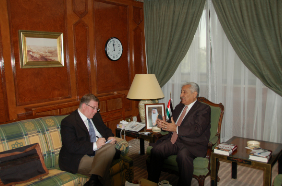
Rosenberg meeting with Jordan’s Prime Minister Abdullah Ensour in Amman as part of the research for “The Third Target.”
These foreboding comments prompted Rosenberg to dig further. After more meetings in Washington, he traveled to Jordan, meeting with Jordan’s Prime Minister Abdullah Ensour, Foreign Minister Nasser Judeh, and Interior Minister Hussein Al-Majali to discuss regional threats. Mentioning potential plot ideas, including a chemical attack and the risk of an overthrow, Al-Majali responded to Rosenberg, “the King has appointed me to make sure the scenario that you are writing about will never happen in our country. But it is a plausible scenario, and that is the problem.”
“What if ISIL tries to set into motion attacks on a number of targets – and what if one of those targets was Jordan, Israel, or the United States?”
After digesting countless intensive interviews with Western and Middle Eastern officials, Rosenberg sat down to write The Third Target, which, soon after the first draft was finished and in light of ISIL’s rapid rise across the Middle East, had its release date pushed up by three months. Published early on January 6th of this year, The Third Target imagines a scenario in which ISIL captures a cache of chemical weapons in Syria, and threatens to deploy them against an unknown city. Rosenberg says,“The question I wanted to ask in this book was, what if ISIL tries to set into motion attacks on a number of targets – and what if one of those targets was Jordan, Israel, or the United States?”
As if the plot was ripped from the headlines and bringing the pages of The Third Target alive, Jordan’s King Abdullah recently stated publicly on CBS News that the battle against ISIL, is, in effect, “our generation’s Third World War.” But in order to stop ISIL and thwart any attempt to attack Jordan, Rosenberg believes that President Obama and the leaders of NATO must view ISIL as “such a significant threat to national security” that the US takes “decisive military action, with no more half measures.”
Rosenberg cites a long-list of realistic military actions that the US is not currently conducting to help destroy ISIL, including not allowing U.S. Special Forces on the ground to provide precise targeting for air strikes, and not permitting 24/7, 7-day a week airlifts of supplies to Kurdish troops fighting in northern Iraq, “even though the Kurds are the most aggressive fighters and the most immediately endangered by ISIL.”
Critiquing the Obama Administration, Rosenberg pulls no punches, saying of Obama’s half-hearted campaign against ISIL that, “This is not working. This is not decisive action. This is foreign policy by press release.” Arguably Obama’s failure to act decisively also lends credibility to the terrifying potential for the ISIL-led chemical weapons attack that is envisioned in The Third Target.
“Obama is also missing the greatest strategic alliance against radical Islam in history.”
But beyond the US not showing up in Paris to show solidarity following the Charlie Hebdo attacks, Rosenberg notes that, “Obama is also missing the greatest strategic alliance against radical Islam in history.” Rosenberg believes three men emerging who are the “Winston Churchill’s of our time, and none of them are in London, Paris or Washington. They are all in the Middle East.”
Rosenberg lists Israel’s Prime Minister Netanyahu, Jordan’s King Abdullah II, and Egypt’s President el-Sisi, as the only global leaders who truly see the existential threat posed to them and to their people by two different, but equally radical Islamic forces: the Shia radicals in Iran, and the Sunni radicals of ISIL. “President el-Sisi and King Abdullah have no qualms calling this a battle against radical Islam,” Rosenberg pointed out, “while President Obama and his Press Secretary refuse to use the term ‘radical Islam’ for fear of being ‘offensive.’” The difference in mentality could not be more stark.
Not only is Jordan committed to fighting radical Islam militarily, Rosenberg says King Abdullah II and his team are also committed to deconstructing radical Islam theologically, stating, “I sat with the King’s men, who explained how they are rallying support among hundreds of Islamic scholars all across the Middle East and the world to explain their version of moderate Islam, and to deconstruct what they call takfiri Islam, which is what the radicals believe.”
“President el-Sisi told the imams that they “must revolutionize and reform modern Islam”, with Rosenberg adding, “Sisi did so at a real risk to his own life in Egypt.”
Rosenberg further cited Egyptian President el-Sisi’s recent speech to Muslim clerics on New Years Day, where el-Sisi told the imams that they “must revolutionize and reform modern Islam,” with Rosenberg adding, “Sisi did so at a real risk to his own life in Egypt.” Netanyahu similarly has spoken out against the threat of radical Islam on numerous occasions. All the while, Rosenberg says, “These are allies at risk, and Obama simply won’t help these men win the battle.”
As ISIL marches, the regular stream of their grotesque snuff films continues to inundate the mainstream news. On the surface, the incomprehensibly evil actions of ISIL seem to be the product of mass delusional hysteria – violence for the sake of violence. But Rosenberg hints at a deeper motive for ISIL and their ilk, one grounded in a strict interpretation of the Quran and hadiths.
“Both the radical Sunnis and Shias have an eschatology – or End Times belief system – that talks about establishing the Islamic Kingdom or Caliphate: the radical Shias are waiting for their Messiah while they build nuclear weapons, before picking an apocalyptic fight with the West or another nation in the region,” Rosenberg explains.
“ISIL…[is] building the Caliphate now, desperately trying to usher in End of Days by killing and enslaving those caught up in their apocalyptic, genocidal vision.”
However Rosenberg contrasts this belief with those of radical Sunnis, such as ISIL, who he says have decided not to wait: they are building the Caliphate now, “desperately trying to usher in End of Days by killing and enslaving those caught up in their apocalyptic, genocidal vision. I spoke to one Pastor in Iraq, who said to me: ‘Joel, this is demonic. When ISIL chops off someone’s head, this is not just terrorizing – these are blood sacrifices to the Islamic State’s ‘God’.’ These are the genocidal conditions emerging in Iraq and Syria.”
In writing The Third Target, Rosenberg hopes to bring readers into the ‘living room’ of the savage, barbaric mindset of ISIL, to help people see how urgent the threat is, and explore why we must act decisively to crush it, “When I started to write this book, I was thinking that the threat was 4 to 5 years away. It moved much faster than I expected.”
Underscoring the intensity of Joel Rosenberg as an author and advocate, and emphasizing his passion when speaking out about these issues, Rosenberg and his family recently made Aliyah to Israel after living their entire lives in the United States. As an evangelical Christian with a Jewish father, Rosenberg says that he wants to use his novels “to inform people in the West, generally, and Christians in particular, that now is the time to stand with Israel, Jordan, Egypt, and all people of good will who will fight against radical Islam.”
He says that he is honoured to stand with Israel in this fight, and notes that in due time his sons will be drafted to serve to protect Israel, “I believe that there is a great movement of Christians around the world who love Israel, who are standing with the Jewish People, and that my role and contribution to Israeli society is trying to educate and mobilize that Christian support for Israel, especially at this time, when the battle against radical Islam is so urgent.” The Third Target is his latest salvo in that fight.

Thursday, August 22, 2013

Settling Israel's Ancient West Bank Roots

Here's my latest article for the Times of Israel based on my first-hand report from a pro-settlement political event that I attended in the West Bank in July: http://blogs.timesofisrael.com/israels-right-to-re-settle/

Enjoy.

-R.O.
--------

Settling Israel's Ancient West Bank Roots
By: Robert D. Onley - August 22, 2013
Times of Israel

The uproar emitted by the Palestinian Authority and the international community after Israel approved new housing blocks in East Jerusalem - on the eve of renewed peace talks - caused many people to seriously question the logic of the State of Israel.

However the casually and widely accepted proposition that any Israeli construction in the West Bank is somehow indisputably wrong is based on a fundamentally flawed understanding of present realities and Israel’s ancient history.

One only has to travel about 45 minutes outside of Jerusalem to have this conclusion become abruptly clear. In mid-July I had the privilege of attending the opening of a new cultural center and synagogue on the historic hilltop in Ancient Shiloh, an area deemed 'occupied' by the international community.

Located in the Ephraim hill-country in the Samarian countryside, the village of Ancient Shiloh was the religious capital of Israel for 300 years before Jerusalem and the existence of the first Temple. Ancient Shiloh was also home to the first tabernacle, Judaism’s earliest holy site, and at one point held the Ark of the Covenant. Both iconic Jewish artifacts pre-date the existence of Islam by over a millennium, and yet the reflexively anti-Israel proletariat in Europe and in the West summarily dismiss the centrality of these artifacts to Jewish identity.

Consider a basic comparative example to appreciate Israel’s alleged defiance of international law when building in Shiloh: in the same way that the ummat al-Islamiyah rightfully upholds the sanctity of the site at the Dome of the Rock, the Jewish people justifiably lay claim to the historic significance of geographic locations such as Ancient Shiloh, the Tomb of the Patriarchs in Hebron, and numerous other areas integral to the Jewish faith.

The Ancient Shiloh area was re-settled in 1978 and officially recognized by the Israeli government a year later. Just like the local Muslim populations in East Jerusalem near the Dome of the Rock, a Jewish population too has gradually grown up around Ancient Shiloh.

In the last few years, efforts by various pro-settlement groups were undertaken to establish a permanent structure to commemorate ancient Israel’s ties to the land at Ancient Shiloh. Embodying this effort is the multi-purpose synagogue and cultural building that opened there in July. The building features a sweeping panoramic view and a super-widescreen theatre displaying a top-notch reenactment film which uses the natural Samarian hillside as a real-life backdrop for the film.

Commemorating the opening of this unique facility attracted the who’s who of Israel's political settlement movement, including politicians Naftali Bennett, leader of The Jewish Home party, and Moshe Feiglin, leader of Jewish Leadership faction of the Likud party and the Deputy Speaker of the Knesset. Their respective political identities and electoral success are based on an unshakeable belief in the historicity and veracity of the Jewish lineage in the land of Israel, including, of course, at places such as Ancient Shiloh.

However, the existence of a factual Jewish lineage does not matter to those whose understanding of Jewish history extends strictly to June 10, 1967, when the borders between the State of Israel and the Kingdom of Jordan were transformed by the Six Day War and Israel’s subsequent occupation of formerly Jordanian land. To many observers, Israel’s decision then to capture additional Jordanian territory still constitutes “theft” of Palestinian land, today.

All of which is problematic because the European Union’s recent decision to boycott Israeli investments in the West Bank is also predicated on this flawed logic. The E.U.’s logic disregards any actual or potential historic Jewish connection to any of the land in the West Bank.

Further, with its latest directive, the E.U. instead dismisses ancient Jewish history as irrelevant, and alternately is implicitly accepting the totality of the P.A.’s assertion of sovereignty over all of “Palestine”. Meanwhile repeated Israeli governments have sacrificed Israeli territory in the pursuit of peace, only to receive rockets and relentless intransigence in return.

Unanswered by the P.A., is that if the 1967 borders are essential to peace for both the P.A. and the E.U., why then were these borders not acceptable in 1967 immediately prior to the Six Day War? Tracing this reasoning further back in history: why were the 1948 borders not acceptable for the creation of a Palestinian state? Legally and objectively, at both points in history – May 1948 and June 1967 – Israel was not “occupying” a square inch of territory in the “West Bank”.

The P.A.’s inability to address these simple yet challenging questions, and the resultant 65 years of bloodshed between Israel and the various Palestinian entities that have expressed vitriolic hatred toward the Jewish people, together raise alarming concern about the fundamental ideological underpinnings of the current and future Palestinian government.

Further, the P.A.’s silence in the face of legitimate objective inquiry exposes its radical agenda, reliance on historic revisionism and perpetual strategic hypocrisy. More than anything, this silence effectively legitimizes Israel’s construction activity, particularly in areas of ironclad historic prominence to Judaism.

At the Ancient Shiloh event, Naftali Bennett, a member of Prime Minister Netanyahu’s governing coalition, made explicitly clear his response to the paradox above, stating:

“The world says that these ‘settlements’ are terrorizing the Palestinian people. I say that not building on this land is terrorism against the Jewish State.”

Bennett’s new party won 12 seats in the 2013 national elections, and he is widely considered an up-and-coming political leader. With peace negotiations now underway, Bennett’s ideological ambition and rising popularity are worth bearing consideration in the context of Israel’s future.

In many respects, Bennett’s vision for Israel’s growth (into the West Bank), emerges from the perception in Israel that the Palestinian government is systemically and intractably divided, riven with venomous jihadi ideologies, and simply incapable of the intellectual maturity required to accept both Jews and the Jewish State on a secular, humanistic, civilizational basis.

That the P.A.’s anti-Semitic political positions are granted hearing in the highest global forums only entrenches Bennett’s belief that Israel must take matters firmly into its own hands, both now and for the foreseeable future.

The reality is that Israel has agreed to come to the negotiating table in 2013 without preconditions. That means: without the basic condition that Israel be accepted as a Jewish State. Is it really any wonder to the international community precisely why Israel continues to build in areas of vital historic importance?

None of this means that Israel has the right to build absolutely anywhere in the West Bank that it deems fit. Nearly all Israelis agree that sensible limits should be placed on construction in areas that will directly impact the ability to create a contiguous Palestinian state - indeed such limits are in Israel's interest when they can lead to definable final status borders.

Yet as the construction at Ancient Shiloh demonstrates, Israel's "settlements" are not necessarily unreasonable or baseless land grabs, but rather are often rooted in ancient, verified history. If only the rest of the world, particularly the E.U. and P.A., would stop to appreciate and construct that conclusion on their own.

Sunday, July 28, 2013

Fortress Israel: Interview with Mark Regev, international spokesman for Prime Minister of Israel

By: Robert D. Onley, J.D.
July 2013

(Jerusalem) - With peace talks between Israel and the Palestinian Authority set to begin after years of impasse, the eyes of the world are once again intensely fixated on the Holy Land. Though a degree of optimism is percolating at the prospect of negotiations for a two-state solution, outside of Jerusalem the State of Israel is facing potential armed conflict on nearly every one of its borders.

In such a hostile neighbourhood, it is often difficult to determine the Israeli government's official position on the myriad regional issues affecting the Jewish State. The reality is that hot button topics such as the Syrian civil war, Iran's nuclear weapons program and Hizbullah's involvement in propping up Assad, are all so interconnected that the Israeli government refuses to comment for fear of complicating the situation.

With this perpetually messy Middle Eastern picture in mind, a visit to the Prime Minister's Office in downtown Jerusalem for an interview with Prime Minister Netanyahu's international spokesman, Mark Regev, provides a much needed inside look at Israel's coldly calculated diplomatic positions.

Though the formal announcement of the resumption of peace talks with the Palestinian Authority would be made by U.S. Secretary State John Kerry the day after this interview was conducted, Mr. Regev, Israel's foremost government representative, public face, and official defender of the State of Israel, offered insight on nearly every issue affecting the Jewish State today.
Mark Regev (L), international spokesman for the Prime Minister of Israel, with Robert Onley at the Prime Minister's Office in Jerusalem. (July 2013)
Robert Onley: Mark, thank you for this opportunity. My title for this interview is: “Fortress Israel in the Collapsing Middle East.” The big picture is this: when you look on the map, you see all the countries around Israel swallowed up in so much instability, but at the center of them all is Israel: secure, solid, and stable.

Mark Regev: More than that, what you’re seeing now in the region is unprecedented instability, violence, tyranny, extremism, fanaticism, and Israel stands out as a stable, prosperous, free democratic country. For many years people brought a theory, some people, that the reason there’s problems in the Middle East, is because of Israel or because of the Israel-Palestinian issue. Obviously we want peace with the Palestinians, we really want peace, we yearn for peace with the Palestinians. But those theories that the reason -- in that large expanse of land, from Morocco on the Atlantic shore through to Afghanistan -- the reason there’s instability, has got nothing to do with us. You have, unfortunately, a whole series of failed states, failed political systems, failed economies, and I think finally more people are beginning to understand, as Prime Minister Netanyahu said when he spoke at the U.S. Congress in 2012, “Israel’s not what’s wrong about the Middle East, Israel’s what’s right about the Middle East.”’

Robert: Given there are these negative global attitudes and opinions about Israel, and looking at current events with near total instability around the region, what do you feel is your primary responsibility as the Prime Minister’s spokesman?

Mark: We’ve got to, in Israel, first of all, defend our country against those who would seek to harm us, and today that’s first and foremost the Iranian nuclear threat. Though there are other threats closer to our borders, whether it’s the terrible situation in Syria, or Hizbullah or Hamas, so [we must] obviously [seek to] protect our people, that’s the first obligation of any country, to protect our people. Unfortunately there are very real threats out there, they are threats that you cannot ignore. At the same time, you want to see [if] it is possible to achieve peace with your neighbours and always to extend the hand for peace and negotiations and to try to move on, to build a better region for all its inhabitants. Thirdly, while doing that, while acting to defend and protect your people, while trying to achieve a new set of peaceful relations, you’ve got to build your country.

And here it is that Israel has much that we can be proud of, because if you look at Israel’s history, in many ways it’s an amazing success story. Today Israel is relatively prosperous, Israel is strong and secure, we can be proud of our democracy here, there are many things that we can look back and say, 'these have been important achievements'. That doesn’t mean we should be complacent about the challenges we face internally [in Israel] -- we have some serious challenges, but we can, I think, from the experience of the last few decades, look to the future with confidence that we can deal with the challenges that we have.

Robert: In your interviews, often the TV hosts can get pretty combative with you, and you’re very good at adapting to what they’re proposing and giving them an alternative. To what extent do you feel your job is to correct the global narrative about Israel, rather than establish it?

Mark: My job is to be Israel’s voice as best as I can. And the job of journalists is often to ask you difficult questions, and for me, it is a matter of great pride to be able to represent my country and it’s not a job that you take for granted, it’s a job that you feel has importance. I enjoy it. I wouldn’t do it if I didn’t enjoy it.

Robert: Turning to Iran, you mentioned that it’s the greatest threat facing Israel, during Prime Minister Netanyahu’s recent appearance on CBS he suggested that Israel might be ready to stop Iran. What is Israel’s greatest fear if it feels forced to conduct unilateral air strikes?

Mark: I’m not going to go into operational details, but I can say the following: in the past the Jewish people were defenseless against threats, and we paid a price, a very severe price for being defenseless. Today we have an independent, sovereign state and the ability to defend ourselves, and that’s something that we take very seriously. We also take seriously the threats coming from Iran. Every time an Iranian leader opens his mouth, and because it’s Iran it’s always a ‘him’ and never a ‘her’, because that’s the nature of the Iranian regime, they say, “Israel has to be wiped off the map” or that, “Israel is a cancer that must be removed.”

Israel would be irresponsible not to take those threats seriously. The marriage between that very extreme regime and the world’s most dangerous weapons is something that we have to avoid at all costs. Now Israel would like to see a peaceful solution, but one way or another, we cannot allow Iran to get a nuclear weapon. We are very serious about that. Deadly serious.

Robert: Shifting to settlements and the two-state solution in its broadest term. Many Western commentators make the claim that Israel’s settlements are the primary roadblock to peace. If you could set the record straight: what is the truth about Israel’s settlement policy? What is it about the realities of the West Bank that these commentators might be misunderstanding?

Mark: The issue of the settlements has to be resolved in peace talks with the Palestinians. The issue of settlements, along with all the other issues that we have disagreements on, that’s the place [negotiations] where they should be resolved. What’s clearly not true, is those who say that the reason there isn’t peace is because of settlements. The best example of that is Gaza, where Israel took down all of the settlements and evacuated them. Did we get peace in return? On the contrary. In fact, if you want to look back even further, those people who say its all about the settlements, well, before 1967, was there peace? The answer is clear. No.

Prime Minister Netanyahu often says, “Some people have historic memory that goes back to breakfast.” Only someone who really didn’t have any historical knowledge could say that the settlements are the reason there’s no peace. I’d even go further, some people say that the reason there is no peace is because there’s no Palestinian state. But we [Israel] have been ready for a Palestinian state and peace and reconciliation for decades. Back in the 1930’s we were ready for two states for two peoples. [We were ready] when the UN put partition on the table in the late 1940’s. The problem is not the Palestinian state, -- we’re ready for that. The problem is: are our neighbours ready to accept the Jewish State in any borders? Because if they are, we can have peace tomorrow.

Robert: Some of Israel’s strongest supporters are evangelical Christians, particularly from the United States and Canada. Across the Arab region we see Christian minorities being persecuted, alongside many religious minorities. In the West Bank, the Israel Defense Forces [have] bases to protect Jewish and other minorities. One challenge that some people fear in the two-state solution, is how might religious minorities be affected. What is Israel's policy toward the minorities that might end up inside potential Palestinian borders?

Mark: I can say the following. Inside Israel, [the] freedom of religion and the protection of the holy sites of all faiths is an integral part of our politics. In other words, we enshrine freedom of religion in our political system. Now, you are correct, that in other parts of the region that is not the case, and in fact we’ve seen in some places, growing intolerance, growing forces that oppose religious minorities [and] that want to see the Middle East just in one colour. That’s an issue: it’s an issue in the larger Muslim world, [and] it’s an issue in the Arab world. Of course, Israel has and will continue to be a bastion for religious freedom and hope our example can be of influence and an example to other countries in the region. We’re aware of the threats.

You’ve got to remember, we’ve also gone through it ourselves. There were thriving Jewish communities across the greater Middle East, in Iraq, in Syria, in Morocco, in Egypt… today what were once thriving communities [are] today, very, very small numbers of Jews in Arab countries, and they left, in part, also, because of intolerance and persecution.

Robert: The Israeli government will not comment on what’s going on in Egypt, to the broader extent…

Mark: No but Prime Minister Netanyahu said that Israel is saying the following: in relations with Egypt, the central issue is maintaining the peace, we have a peace treaty with Egypt, we want to see that treaty honoured, maintained, and that’s our focus.

Robert: Briefly, could you comment on the relationship with the now ousted Morsi government? What is the difference?

Mark: I don’t want to go into anything that could be perceived as interfering in internal Egyptian affairs, except to say to all Egyptians, that Israel believes that peace has been good for both our countries, that peace has been a cornerstone for stability in our region, and that we have to protect the peace and maintain the peace.

Robert: Turning to Syria, how would you characterize Israel’s relationship with Assad prior to the civil war?

Mark: Assad was, and is, one of the few Arab leaders that was formally in the Iranian orbit. The Syrian Regime under Assad and his father was a bastion of support for Hamas and Hizbullah and Islamic Jihad, the most radical and extreme anti-Israel groups. Assad never was, never has been, someone that we could look on as a stabilizing or moderate influence.

Robert: What would Israel’s position be with respect to potential Western or NATO intervention in Syria?

Mark: We’re being very careful not to give public advice. We think that a public position by Israel would be detrimental. We will respect the decisions made in Washington and other Western capitals. For obvious reasons, we have very special concerns, specifically the large stockpile of weapons that are in Syria, and to ensure that in the framework of a fragmenting Syria, those weapons don’t get into the hands of some very dangerous actors, first and foremost, Hizbullah.

Robert: Speaking of weapons and Syria’s relationship with Russia in particular: how would you describe Israel’s broader relationship with Russia, in the context of what’s happening in Syria and Iran and that issue?

Mark: We have a dialogue with Russia, the Prime Minister recently just met with [Russian President] Putin in Russia, and the Russians are aware of our concerns.

Robert: One issue that’s not on the front burner at all, is Israel’s recent discovery of enormous natural gas reserves in the Mediterranean. Does Israel foresee potential conflict over these reserves?

Mark: No. There’s no reason to have conflict over the reserves. It’s interesting, because for the first 65 years of our independence, we were sure that we were a country that was not blessed with the abundant energy supplies that our neighbours had, and the fact that 65 years after our independence we’ve discovered large energy reserves is a miracle. It’s a good thing. 

What’s especially good is that for 65 years we’ve developed a country on the basis that we don’t have natural energy reserves, and so we had to invest in our people, in our education, we had to be competitive, we had to be good without natural energy reserves. Now today we’ve got natural energy reserves and so that’s like the icing on the cake. Who would’ve thought ten or twenty years ago that Israel would be becoming an exporter of energy? That’s the reality, and that’s important for Israel.

You’ve got to remember that the Israeli taxpayer has burdens that no other taxpayer on this planet has, a defence burden that cannot be ignored, and energy exports will make us have the ability to earn revenues that will allow Israel to do things for our people that they deserve, whether its reduced taxation, more money for social services, increasing funding for education and so forth, it’s a good thing. And it could also be a vehicle for regional cooperation.

Robert: Do you foresee that these revenues could be part of some sort of peace agreement with the Palestinians?

Mark: We’re open to have gas cooperation with different countries in the region.

Robert: In the bigger picture, after the recent [Israeli military] operation in the Gaza Strip, and seven years ago now the war with Hizbullah in the north, plus instability in Syria: does the prospect of a multi-front war function into decision making in Israel?

Mark: Obviously, we’ve been attacked by Hizbullah in the north, Hamas in the south, and we are aware that they could do both at the same time. It’s the job of our defence establishment to prepare for worst case scenarios, they would be irresponsible if they didn’t make such preparations, and it’s the job of other people to work for the best case scenarios, which is, can we have peace and stability and work with our neighbours more effectively? 

That’s our challenge: to prepare for the worst, and to work for the best. That’s why we’re 100% behind the recent American effort to try to get the peace process back on track with the Palestinians, we hope the Palestinians will be ready to talk peace. We’re aware of the threats out there, whether its Hamas or Hizbullah, and we have to make sure that we can deal with those threats if need be.

Robert: Canada has been one of Israel’s most vocal supporters in recent years, what does that mean for Israel in the world today and for Israel going forward?

Mark: Canada has always been a good friend of Israel and today more so than ever. Prime Minister Netanyahu considers Stephen Harper, Prime Minister of Canada, not only a good friend of Israel, but a good personal friend. There’s no doubt that Canada has taken a moral leadership [position] that we appreciate and [that] we think is an example for others. Sometimes you go to an international forum and there’s the standard anti-Israel resolution, not balanced, supported by the Arab countries and some of their automatic allies, [and] Canada will stand up and say, "This is wrong and we refuse to support it". In Canada you see moral leadership, standing up for the truth, and Israel appreciates it greatly.

(Special thanks to Mark Regev, David Baker, Jacob Waks and John Hansen for facilitating the interview.)

© The World Assessor, 2013
By: Robert D. Onley - robert@robertonley.com

Wednesday, July 3, 2013

Egyptian President Morsi Ousted in Coup

While the pace of events makes it hard to determine if this qualifies as a classical "military coup", today Egypt's Islamist President Morsi was ousted from power after the Egyptian military announced the suspension of the (increasingly Islamist) Constitution. The chief justice of the constitutional court will take on former President Morsi's powers as the interim head of state. 

These developments follow weeks of intense popular protests by tens of millions of Egyptians, and flashes of violence across Egypt. With an economy in free fall, Egyptians simply had enough.

The significane of this moment cannot be understated. The Muslim Brotherhood, as a global political and religious force present in numerous countries (but headquartered in Egypt), has just been dealt a massive setback. The removal of Morsi will have ramifications across the Middle East.

The Western world's reaction to the ouster of Morsi, particularly after his democratic election last year, will also be intriguing to watch. Already, reports in the Canadian and American media have discussed the potential suspension of aid to Egypt, in the wake of what is quickly being deemed an upheaval of the people's democratic will. I'm not convinced that this is the case. 

Morsi made a number of rash, Islamist-motivated political decisions that quickly backfired, as millions of liberal and secular Egyptians simply rejected these backward moves. Most notably, Morsi forced through a highly controversial Islamist Constitution that did not reflect the will of the people. In response, the people reacted with massive, peaceful protests. 

The secular opposition rose up. The people have spoken; the Army has responded. What happens next is up to the Egyptian people, once again. - R.O. 

Other headlines:

--------------------------------------------------------------------------------------------
Army ousts Egypt's President Morsi - BBC News
3 July 2013 - 4:57pm
Pro-Morsi supporters. (JPost.com)
The head of Egypt's army has given a TV address, announcing that President Mohammed Morsi is no longer in office.

Gen Abdul Fattah al-Sisi said the constitution had been suspended and the chief justice of the constitutional court would take on Mr Morsi's powers.

Flanked by religious and opposition leaders, Gen Sisi said Mr Morsi had "failed to meet the demands of the Egyptian people".

Anti-Morsi protesters in Cairo gave a huge cheer in response to the speech.

The army's move to depose the president follows four days of mass street demonstrations against Mr Morsi, and an ultimatum issued by the military which expired on Wednesday afternoon.

TV stations belonging to Mr Morsi's Muslim Brotherhood went off air at the end of the speech and state news agency Mena said managers at the movement's Misr25 channel had been arrested.

Minutes later, a notice went up on Mr Morsi's Facebook page denouncing the army move as a "military coup".

The statement asked Egyptian citizens - both civilians and military - to "abide by the constitution and the law and not to respond to this coup".

The ousted leader's current whereabouts are unclear. However, earlier reports said security forces had imposed a travel ban on both him and other leading figures in the Muslim Brotherhood.

'Roadmap' for the future
General Sisi said on state TV that the armed forces could not stay silent and blind to the call of the Egyptian masses.

He spoke of a new roadmap for the future, and said that the chief justice of the Supreme Constitutional Court, Adli Mansour, would be given the task of "running the country's affairs during the transitional period until the election of a new president".

After Gen Sisi's address, both Pope Tawadros II - the head of the Coptic Church - and leading opposition figure Mohammed ElBaradei made short televised speeches about the new roadmap for Egypt's future which they had agreed with the army.

Mr ElBaradei said the roadmap aimed for national reconciliation and represented a fresh start to the January 2011 revolution.

"This roadmap has been drafted by honourable people who seek the interests, first and foremost, of the country," added Pope Tawadros.

Fireworks

The army is currently involved in a show of force, fanning out across Cairo and taking control of the capital, BBC correspondent Quentin Sommerville reports.

He described seeing eight armoured personnel carriers heading for Cairo University in Giza, where one of the main pro-Morsi demonstrations was being held.

The tens of thousands of anti-Morsi protesters on the streets of Cairo are now celebrating, with fireworks lighting up the night sky and car drivers honking their horns in excitement.

But Morsi supporters elsewhere in the city are reported to have shouted: "No to military rule.''

Morsi, army ready for showdown in 'final hours' in Egypt

This has bad news written all over it. Take a read of just a few select quotes:
Egypt's army commander and Islamist President Mohamed Morsi each pledged his life to defy the other as the hour approached on Wednesday that will trigger a military takeover that was prompted by mass demonstrations.
...Morsi refused to give up his elected office. Morsi said, "The price ... is my life." 
...Liberal opposition leaders, who have vowed not to negotiate with Morsi since the ultimatum was issued, immediately denounced his refusal to go as a declaration of "civil war".
Egypt is entering very tenuous times. Is the world ready for two civil wars on Israel's border? - R.O.
----------------------------------------------------

Morsi, army ready for showdown in 'final hours' - JPost
By REUTERS
07/03/2013 07:23

Egyptian President Mohamed Morsi defies army, US pressure to bow to protests as clock ticks on army ultimatum for his resignation; army commander issues bellicose statement, says he is ready to die.


A girl with the colours of the Egyptian flag and the word "leave" painted on her face Photo: REUTERS

CAIRO - Egypt's army commander and Islamist President Mohamed Morsi each pledged his life to defy the other as the hour approached on Wednesday that will trigger a military takeover that was prompted by mass demonstrations.

The military chiefs issued a call to battle in a statement headlined "The Final Hours". They said they were willing to shed blood against "terrorists and fools" after Morsi refused to give up his elected office. Morsi said, "The price ... is my life."

As a mass of revelers on Cairo's Tahrir Square feted the army for saving the revolutionary democracy won there two years ago, supporters of the president's Muslim Brotherhood denounced a "military coup". Some clashed with security forces at Cairo University, where 16 people died and about 200 were wounded.

Military sources told Reuters the army had drafted a plan to sideline Morsi and suspend the constitution after a 5 p.m. (1500 GMT) deadline passes. Coordinated with political leaders, an interim council would rule pending new elections. The sources would not say what was planned for an uncooperative president.

Facing the expiry of a 48-hour ultimatum set by the head of the armed forces that he should agree a power-sharing deal with his rivals, Morsi broadcast a defiant, if somewhat rambling, address to the nation to defend his "legitimacy" - a word he used repeatedly in the course of 45 minutes.

Liberal opposition leaders, who have vowed not to negotiate with Morsi since the ultimatum was issued, immediately denounced his refusal to go as a declaration of "civil war". The youth movement that organized the mass protests urged the Republican Guard to arrest Morsi immediately and present him for trial.

Three hours after his midnight television appearance, the military high command responded with a post on its Facebook page. The post said they, too, were willing to lay down their lives to defend their position - one which they described as defending the Egyptian people from "terrorists, radicals and fools".

A military source said the message came from General Abdel Fattah al-Sisi, the armed forces commander appointed by Morsi last year, who issued the ultimatum to politicians on Monday.

It was posted on the official Facebook page of the Supreme Council of the Armed Forces, or SCAF. It entered history books as Egypt's ruling institution after the army pushed aside Hosni Mubarak in the Arab Spring uprising of early 2011.

"It is an honor for us to die rather than that anyone should terrorise or threaten the Egyptian people," it said. "We swear to God, we will sacrifice even our blood for Egypt and its people to defend them against any terrorist, radical or fool.

"Long live Egypt and its people."

PROTESTS

The army has taken its cue from the millions who rallied on Sunday to call for Morsi's resignation as he completed a year in office. It appears to have only enhanced the high regard in which the military is held by most Egyptians by its action.

But as well as listening to the voice of protesters, the army also appears to have had its own concerns about the way Morsi was leading the country - notably about his alliances with more radical Islamist groups and recent association with sectarian calls to holy war in Syria.

The opposition say offers by Morsi to include them have been made in bad faith by a leader beholden to a religious movement intent on entrenching its power and Islamic ideas forever. The Brotherhood calls them bad losers who do not grasp democracy.

Sisi, a 2006 graduate of the US Army War College, has insisted he is not seeking power in the long term. Many believe the armed forces - with their extensive economic interests and generous funding - when they say they have no political ambition.

The United States has urged compromise. It has funded the army for decades, since long before the fall of Mubarak in 2011, as a key part of helping secure Washington's ally Israel. Morsi aides have said they believe a coup would need US support.

Washington has also defended the legitimacy of Morsi's election to lead the biggest Arab nation, as part of a strategy of promoting democracy in the Middle East since the Arab Spring.

President Barack Obama told Morsi by telephone that talks with opponents were needed. Morsi said on Twitter that he would not be "dictated to internally or internationally".

A senior European diplomat said world powers would have no choice but to condemn the military removal of an elected head of state, even if the generals have support on the streets.

In his television address, Morsi warned that any deviation from the democratic order approved in a series of votes last year would lead Egypt down a dangerous path.

It was unclear who fired at whom or who started the violence at Cairo University. Muslim Brotherhood supporters angrily held up rifle and shotgun cartridges after scenes of mayhem, shrouded in teargas. State television quoted a health ministry official as saying 16 people died and about 200 were hurt.

That made it by some way the bloodiest incident in several weeks of street fighting. Eight people were killed the previous day during a siege of the Brotherhood's national headquarters and the movement has said it is under attack from hired "thugs" left over from the days of Mubarak's secret police.

MURSI DEFIANT
"The price of preserving legitimacy is my life," Morsi said in an impassioned, repetitive address to the camera. "Legitimacy is the only guarantee to preserve the country."

In a warning aimed as much at his own militant supporters as at the army, he said: "We do not declare jihad (holy war) against each other. We only wage jihad on our enemies."

Urging Egyptians not to heed the siren calls of what he called remnants of the former authoritarian government, the "deep state" and the corrupt, he said: "Don't be fooled. Don't fall into the trap. Don't let them steal your revolution."

Condemning a coup against their first freely elected leader, tens of thousands of Muslim Brotherhood supporters took to the streets, clashing with opponents in several towns.

But they were dwarfed by anti-government protesters who turned out in the hundreds of thousands across the nation.

"Morsi - Game Over - Out", proclaimed a laser display beamed over Tahrir Square, where people danced with joy, recalling the euphoria and the slogans that greeted the overthrow of Hosni Mubarak. The light show counted the hours to 5 p.m.

Despite his fighting talk, time appears to have all but run out for Morsi. Ministers have resigned and aides abandoned him.

Military sources told Reuters that, assuming the politicians fail to end a year of deadlock before the deadline, the generals have their own draft program ready - although it could be fine-tuned in consultation with willing political parties.

Under the road map, the military would install an interim council, composed mainly of civilians from different political groups and experienced technocrats, to run the country until an amended constitution was drafted within months.

That would be followed by a new presidential election, but parliamentary polls would be delayed until strict conditions for selecting candidates were in force, the sources said.

They would not say how the military intended to deal with Morsi if he refused to go quietly. Some of his Islamist supporters have vowed to defend what they see as the legitimate, democratic order, even if it means dying as martyrs. Some have a history of armed struggle against the state.

TROOPS

Troops intervened to break up factional clashes in the city of Alexandria. They were also out on the streets of Suez and Port Said, at either end of the Suez Canal. The waterway is vital to world trade and to Egypt's struggling economy.

Beyond it, the Sinai peninsula has seen militant groups thrive since Mubarak fell, worrying neighboring Israel.

The Brotherhood's political wing called for mass counter- demonstrations to "defend constitutional legitimacy and express their refusal of any coup", raising fears of violence. But the biggest pro-Mursi rally in a Cairo suburb appeared to attract around 100,000 supporters, Reuters journalists said.

Senior Brotherhood leader Mohamed El-Beltagy told the crowd: "We give our lives in sacrifice for this great legitimacy. ... We swear by almighty God to protect the will of these people and to not let it go, even if in doing this we sacrifice our souls."

But the Brotherhood long avoided direct confrontation with the security forces despite its oppression under Mubarak.

For many Egyptians, fixing the economy is key. Unrest since Mubarak fell has decimated tourism and investment and state finances are in poor shape, drained by extensive subsidies for food and fuel and struggling to provide regular supplies.

The Cairo bourse, reopening after a holiday, shot up nearly 5 percent after the army's move.

This week has made Sisi a household name in Egypt, but he remains a man of some mystique. Steve Gerras, a retired colonel in the US Army who was Sisi's faculty adviser at the Army War College, described him to Reuters as a serious student.

Calling him "pious, kind, thoughtful", the behavioral science professor said: "He was a serious guy. He is not a guy who would go to a stand-up comedy show. But at the same time ... his eyes were always very warm. His tone was very warm.

"He was passionate about the future of Egypt."