Thursday, March 27, 2014

Wrap-up: YDC at the 2014 Nuclear Knowledge Summit

Last week I had the great privilege of leading the Canadian Delegation for the Young Diplomats of Canada (YDC) at the inaugural 2014 Nuclear Knowledge Summit (NKS) in Amsterdam, Netherlands. After a whirlwind 72-hours of meetings, the YDC Delegation returned home with fresh insights and critical thoughts about some of the most pressing issues facing the globe. 

As it is difficult to adequately summarize the intensive topics that were covered at the NKS in a single brief blog post, the YDC Delegation (bios here) will be researching and writing a feature length paper about the NKS to be shared at a later date. 

But for a quick look at the event, check out the Young Diplomats Forum blog for my wrap-up post on YDC’s participation at the NKS: http://youngdiplomatsforum.wordpress.com/2014/03/26/nkswrapup/
-R.O.
--------------------------------------------------------------------------------------
Wrap-up: YDC at the 2014 Nuclear Knowledge Summit
By: Robert D. Onley, Head Delegate, Canadian Delegation

After a whirlwind 72-hours attending the inaugural Nuclear Knowledge Summit (NKS) in Amsterdam from March 20-22, 2014, the Young Diplomats of Canada (YDC) Delegation returned home with fresh insights and critical thoughts about some of the most pressing issues facing the globe. As it is difficult to adequately summarize the intensive topics that were covered at the NKS in a single brief blog post, the YDC Delegation (bios here) will be researching and writing a feature length paper about the NKS to be shared at a later date. What follows is a quick look at YDC’s participation at the NKS:


THE OPENING OF THE 2014 NUCLEAR KNOWLEDGE SUMMIT, AMSTERDAM, NETHERLANDS, 20 MARCH 2014.

The challenge of securing the world’s stockpile of nuclear materials and ensuring continued peaceful nuclear development is one that the world’s next generation of global leaders will have to comprehensively confront, and with that in mind the Young Diplomats of Canada team entered the NKS seeking to gain understanding into the complex world of nuclear diplomacy.

The 2014 NKS was the first of its kind and was the natural outgrowth of three successful Nuclear Security Summits (held in 2008, 2010 and 2012 respectively). The NKS gathered knowledge experts, academics and nuclear NGO representatives from around the world for three days of intensive meetings, panels and keynote addresses, all designed to tackle the multiple problems facing the global nuclear security regime.

Prior to the opening of the NKS, the YDC Delegation was honoured to have the opportunity to visit the Canadian Embassy in the Netherlands at The Hague, to meet with Canada’s Ambassador, Mr. James Lambert, for over an hour. The Delegation enjoyed a high-level discussion about Canada’s role within the NSS framework, the importance of multilateral diplomacy, and the life of a diplomat.


THE YDC DELEGATION WITH CANADIAN AMBASSADOR JAMES LAMBERT AT THE CANADIAN EMBASSY IN THE HAGUE, 20 MARCH 2014.

Adding to the discussion was the Counsellor of the Canadian Embassy, Mrs. Ann Flanagan Whalen, who extended the conversation into a full scale dialogue on digital diplomacy, the use of social media, and the nature of the Canada-Netherlands bilateral relationship. The YDC Delegation seized the opportunity for direct contact with high-ranking Canadian Foreign Service Officers, and benefited from an honest chat about serious national and international issues.

As the only Canadian youth delegation accredited to attend the NKS, the Young Diplomats of Canada were uniquely positioned to represent the Canadian voice at this important international event. Outside of two Canadian Department of Foreign Affairs officials who were listed in attendance, YDC’s Delegation was the only Canadian group to be formally invited to attend.

However through extensive outreach efforts, YDC was able to meet with two other youth delegations attending the event: Young European Leadership and the Netherlands-based PUSH! for Disarmament group, who joined YDC in representing the global youth voice at the NKS. Though the youth delegations were small in number, collectively they represented the single largest recognized group at the event.
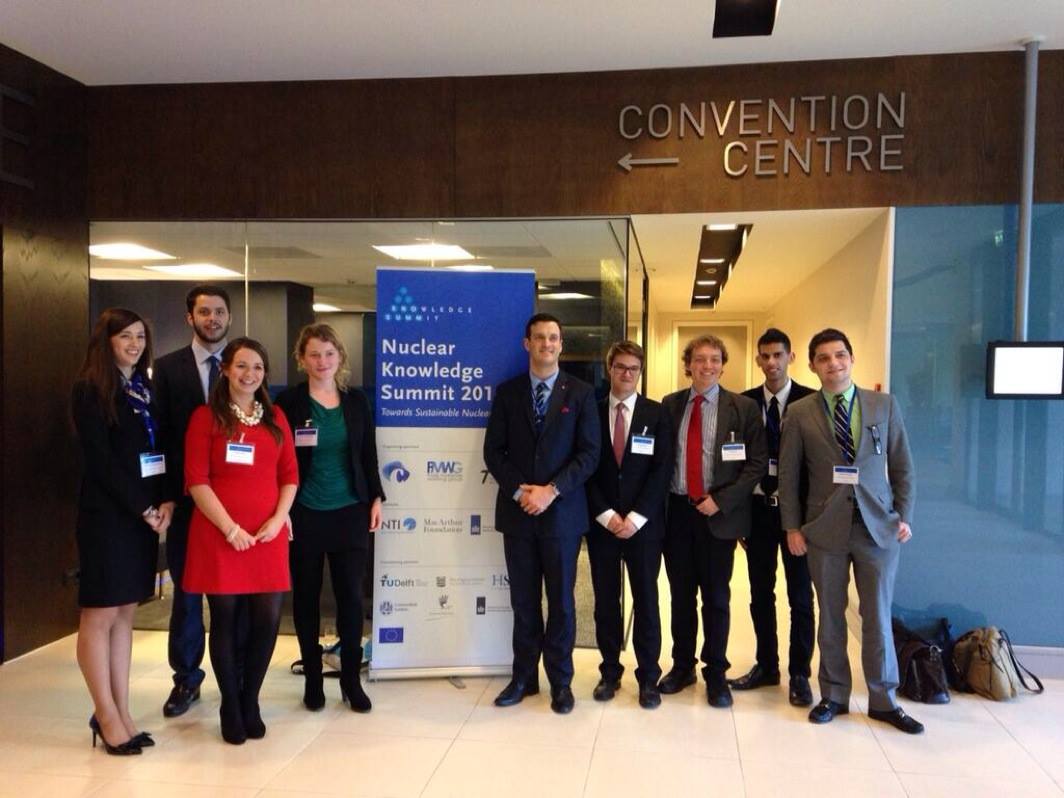

THE YEL, YDC AND PUSH! DELEGATIONS TOGETHER AT THE NKS.

More importantly, through the PUSH! for Disarmament group’s production, the youth voice was the only one to be granted the privilege of presenting a video at the closing ceremony of the NKS. This was a significant, and symbolic accomplishment.


PUSH! PRESENTS AT THE CLOSING CEREMONY

During the NKS, delegates listened to a variety of high level speakers from across the nuclear industry. Among the speakers was a critical address from the Director of Nuclear Security at the International Atomic Energy Agency, Dr. Khammar Mrabit, who opened the NKS with a thought-provoking assessment on the state of nuclear security. As part of the first panel on “Improving Regime Cohesion”, Dr. Mrabit set out a complete plan for continuing with the spirit of the Nuclear Security Summit efforts after the present round of bi-annual summitry runs its course. (This theme will be explored in depth by the YDC Delegation in its forthcoming research paper).


THE IAEA NUCLEAR SECURITY PLAN PRESENTED BY IAEA DIRECTOR OF NUCLEAR SECURITY, DR. KHAMMAR MRABIT

Further panels included a discussion on cybersecurity and the nuclear industry, which was a hot topic and one that garnered extensive attention from the audience during the question and answer period. Bringing much needed global perspective was the panel on “Regional Approaches to Nuclear Security”, which assessed specific issues related to security concerns in all corners of the world. Directly related to this challenge was the panel on securing fissile materials and radiological sources – both are key elements for the peaceful nuclear energy industry, but are vulnerable to theft from terror groups who seek to use the materials for nuclear attacks.

Outside of the formal program, the YDC Delegates were able to network with these nuclear experts, discuss common concerns and continue the panel discussions in greater detail. Through official meals, the Delegates had a chance to mingle in a more casual setting, and get to know the other youth delegations.


THE YDC DELEGATION ENJOYS DINNER DURING THE CLOSING CEREMONY.

Leaving the NKS, the key theme that the YDC Delegates took away is that the bi-annual Nuclear Security Summit (NSS) process will likely come to an end in 2016. As such, meetings such as the NKS are vital to ensuring that the global dialogue about these issues not only continues, but is continued in a comprehensive, targeted and logical way.

Whichever format future nuclear security meetings will take, through participation in events like the NKS, the Young Diplomats of Canada seeks to build Canada’s next generation of global leaders through access to hands-on diplomatic events.

Robert D. Onley was the Head Delegate of the Canadian Delegation at the 2014 Nuclear Knowledge Summit in Amsterdam, and serves as Legal Counsel and Director of Policy and Development for the Young Diplomats of Canada. He can be contacted at legal@youngdiplomats.ca.

Saturday, March 15, 2014

"Why Our Future Depends on a Neutral Internet" - Published in Huffington Post

Here is my first article for the Global Shapers Community published today by The Huffington Post, titled, "Why Our Future Depends on a Neutral Internet."

The article was written in consideration of the upcoming centennial of the First World War, and calls for humanity to reflect on the implications of that war in light of our modern hyper-connected reality. Enjoy. - R.O.

http://www.huffingtonpost.ca/global-shapers-community-ottawa/global-shapers_b_4967133.html
------------------------------------------------------------------
"Why Our Future Depends on a Neutral Internet."
The Huffington Post - 15 March 2015
By: Robert D. Onley, Global Shaper in the Ottawa Hub

As we approach 100 years since the outbreak of the First World War in 1914, it is imperative to appreciate the magnitude of that global catastrophe and contrast that dark period with the overwhelming potential that our networked civilization now possesses in 2014.

Rising from the trenches, humanity has established mesmerizing infrastructure that allows instantaneous communication through high-speed mobile internet and near omniscient search capabilities. Such power has made the prospect of transformational change and cooperative development seem limitless.

But just as no one living in 1914 could have foreseen the exponential horrors of the Second World War a mere twenty-five years later, likewise today we face the simultaneous onslaught of technological advances and government-sanctioned invasions of privacy, whose combined long-term ramifications for humanity are simply unknowable.

Such uncertainty about our collective digital future demands careful scrutiny of our governing practices today, and necessitates the development of visionary information policies which comprehensively confront these complex dilemmas.

Individually, this is a daunting task for even the most socially aware global citizen. However our modern-day capacity to connect, build and share has never been greater. One organization with the intellect and will to help tackle these challenges head-on is the World Economic Forum's Global Shapers Community, an exclusive network of 3000 young leaders who are daily demonstrating what is possible when people unite.

Global Shapers seek to better the state of the world through city-based Hubs of young professional leaders who are exceptional in their potential, their achievements, and their drive to make a contribution to their communities.

Through support for initiatives like Global Dignity Day, Solar for Syria and numerous education programs, Global Shapers are leveraging the internet to unite communities and give hope in an era of increasing conflict, sectarianism and despair.

These young professionals are also thought leaders in their own right, passionate about foreign affairs, and seek to understand the drivers of future conflicts in order to counter them with actionable solutions.

In reflecting on the Great War's centennial, the Shapers recognize that the internet has become so pervasive and so routine that most people take for granted the very fact that billions of us are now perpetually 'online'.

Given this reality, it has become necessary to disconnect, pause, and examine the state of the world, as recent events have unfolded to expose a choice facing humanity which will decide the fate of generations to come.

Revelations about governments reading emails, spying on video chats, and listening in on phone calls, have done nothing to halt the continued growth of these plainly compromised platforms. Our dependency on these tools appears irreversible.

The conclusion is that many have unconsciously conceded defeat in the battle that is being waged for the future of information and the control of knowledge.

Briefly examine the sheer capability of Google, for example, by no means singling out the company. Any number of web-based companies could be similarly assessed.

Nonetheless in our present world, there exists a single corporate entity -- Google -- which controls the vast majority of transnational information flows for the most advanced economies. Its reach into the daily lives of billions of citizens is unmatched, and its appetite for growth in all areas is exponential.

Google's informal corporate motto, "Don't be evil", is only passively reassuring when one considers Google's venture capital group purchasing the military robot research company Boston Dynamics.

The latter development is amplified as the world witnesses the propaganda and cyber wars between the West and Russia over Crimea. In such a context we must decide to what end profit-driven web corporations such as Google can wield their unprecedented control of information flows, search results, and communications technologies.

As the preeminent internet hyperpower in 2014, Google uniquely bears the significant burden of being almost completely responsible for -- and capable of influencing -- the choice we face between one of two worlds:

The first choice is to entrench ourselves in the increasingly hostile, selectively curated and self-serving Internet nether-realm of hacking, pervasive spying, and digital thievery. The trajectory of this choice leads to the active segregation of the global commune into 'state internets' (as exists in China), recreating the walled off nationalist borders which have historically sparked widespread conflict.

The alternative is a web-based world that supplies information neutrally and universally, collaborates freely and shares legally, and is one that collects user data solely to support the transparent backbone of a renewed human condition of collective responsibility.

It is in this open world, pluralistic and non-partisan, where the Global Shapers Community thrives, by creating and facilitating opportunities for some of the brightest young leaders to work together to better the state of the world. In Part 2 of this series, we will examine how we can collectively shape the rules that govern our web-based future.

By Robert D. Onley, a Global Shaper in the Ottawa Hub.

Saturday, March 1, 2014

How Far Will Putin Go?

Exceptional analysis.

http://www.foreignpolicy.com/articles/2014/03/01/putin_russia_ukraine_intervention_war

Sunday, January 19, 2014

Testing the Canada-Israel alliance

Here's my latest op-ed for the Times of Israel, titled: "Testing the Canada-Israel alliance". Enjoy. - R.O.
http://blogs.timesofisrael.com/testing-the-canada-israel-alliance/

----------------------------------------------------
"Testing the Canada-Israel alliance"
By: Robert D. Onley - 20 January 2014

The inaugural visit of Canadian Prime Minister Stephen Harper to Israel represents a significant moment for an Israeli government that is in vital need of dependable friends and reliable moral allies. Much has already been said about Prime Minister Harper’s unequivocal and unparalleled support of Israel since being elected in 2006.

Indeed because the governments of Canada and Israel see eye-to-eye on nearly every geopolitical issue facing the Jewish State, an important question must be asked about the long-term nature of this bilateral relationship, as the Canada-Israel alliance could soon be tested in both word and deed.

Though the United States remains Israel’s unquestioned military ally, many observers note the increasing willingness of the Obama Administration to publicly object to all of Israel’s policies – on the Palestinian peace process, on settlement construction, and most notably on the negotiations over Iran’s nuclear weapons program.

The latter is most troubling when coupled with the obvious intent of the United States to codify a questionable “final nuclear deal” with the Iranian government later this year and thus absolve the U.S. of any potential military response toward the issue.

Of course it is unsurprising that after two long wars in the Middle East, the United States is ready to step off the stage. Nonetheless the timing could not be worse, as Iran appears to be using present negotiations to buy time for the development of its Persian Bomb.

For example the delay between the announcement of the P5+1′s “interim deal” with Iran on November 24, 2013 in Geneva, and the final text of what then became the “preliminary deal” actually enacted on January 17, 2014, emphasizes Iran’s disconcerting abuse of process.

Accordingly under the Harper government, Canada has stated that it is “deeply skeptical” about the deal, which will hopefully see Iran scale back its nuclear work in exchange for the West easing multiple layers of sanctions which were painstakingly agreed upon by the largely disunited U.N. Security Council.

Canada shares Israel’s primal fear about whether or not the Iranian government can be trusted to live up to the terms of the deal. But aside from echoing Netanyahu’s pessimism about the trustworthiness of the radical theocratic regime in Tehran, it would appear that Canada can contribute little toward stopping Iran’s covert march toward nuclear weapons.
Prime Minister Benjamin Netanyahu (R) seen with his Canadian counterpart Stephen Harper during a welcoming ceremony for Harper at Netanyahu’s office in Jerusalem January 19, 2014.
To be sure, there is likely cooperation between Canada and Israel on the espionage and sabotage of Iran’s nuclear weapons program, just as there is with many Western powers.

However in the context of Canada and Israel’s growing alliance, consideration must be given to what might transpire between the nations if diplomacy with Iran ultimately fails. In such a scenario – one that has undoubtedly been war-gamed – Canada’s steadfast moral support of Israel, and Harper’s fundamental belief in Israel’s unique position within the Middle East, will be tested in the flesh.

If there is any government on earth that based on its public statements alone appears willing to ensure Iran never obtains a nuclear weapon, it is Canada; not France, not the U.K., not Italy and not Germany. None of these Western nations even come close to Canada in levying consistent condemnation of Iran’s rhetoric and in pronouncing warnings about the threat posed by Iran’s nuclear weapons program.

Moreover if there is one government on earth that would publicly and defiantly endorse an Israeli decision to conduct unilateral military strikes against Iran’s nuclear program, again it is Canada. This would be no small measure for a “middle power” like Canada, closely allied with the United States but fiercely carving its own identifiable policy in the Middle East apart from its natural Western allies.

The Netanyahu government’s recent criticism of the European Union‘s “hypocrisy” toward Israel bears out Canada’s policy independence on the myriad issues affecting Israel.

Canada’s nearly solitary voice of moral support for Israel is also reflected in comments made by Rafael Barak, Israel’s ambassador to Canada. Speaking to the Canadian media recently, Barak stated,
“We see Iran as a serious threat. Canadians have the same view. I feel that other countries have the same view, but the difference is that Canada is expressing their ideas in public.”
The biggest question for this alliance in early 2014 is whether the Harper government would back up its public expressions with tangible action, either to facilitate effective military strikes on Iran’s nuclear sites, or perhaps more reasonably to help protect the Jewish homeland against Iranian counter-strikes through cooperative defensive military manoeuvres.

The Canadian Forces gained invaluable counter-terrorism experience in over ten years of fighting in Afghanistan (where it bore a disproportionate number of combat losses compared to its ISAF partners) and is adept at assisting in disaster relief operations: might Israel call upon Canadian help if Iran unleashes Hezbollah against the Jewish State? Such a seemingly hyperbolic scenario cannot simply be ignored.

If Netanyahu is in fact preparing for unilateral military action against Iran, as is perennially reported, it is reasonable to suggest that amid all the other nations, Canada alone might be asked for even the smallest contribution on or after that fateful day. This suggestion is particularly probative if the Obama Administration refuses to give Netanyahu a “green light” for the mission. Harper may in fact be the only friend Netanyahu will have to call for help.

These are topics rarely explored in light of Canada’s relatively small military capacity, as some would immediately dismiss out of hand the idea of Canada providing military assistance to Israel.

Perhaps the Harper government would rather not publicly breach such a discussion for fear of unnerving its domestic audience, and this much is understandable. Nonetheless Canada’s unwavering moral alliance with Israel since 2006 clearly provokes legitimate inquiry in the event that Israel’s “D-Day” with Iran arrives.

There is no question that both Israel, Canada and the world desires a peaceful resolution to the stand-off with Iran over its illicit nuclear weapons program. Diplomacy, as it is occurring today, should indeed be given a chance. The unfortunate reality is that time is not on the side of those who seek to prevent the proliferation of nuclear weapons.

As Canada’s lonely stand with Israel makes clear, neither country operates in the realm of diplomatic wishful thinking. Rather, the Canada-Israel alliance recognizes the ruthless reality of the hate-filled, anti-Semitic dystopia that Israel’s enemies, like the Iranian regime, never cease to concoct and broadcast right next door. As Harper visits Netanyahu in Israel this week, this reality is surely on their agenda.

Read more: Testing the Canada-Israel Alliance | Robert David Onley | Ops & Blogs | The Times of Israel http://blogs.timesofisrael.com/testing-the-canada-israel-alliance/#ixzz2quL0Fkt0
Follow us: @timesofisrael on Twitter | timesofisrael on Facebook

Tags: Harper visits Israel, Canadian visit to Israel, Prime Minister visits Israel, Canadian delegation trip to Israel, Harper meets Netanyahu, Harper in Israel, Harper in Jerusalem, Prime Minister in Israel