Showing posts with label nuclear. Show all posts

Thursday, March 27, 2014

Wrap-up: YDC at the 2014 Nuclear Knowledge Summit

Last week I had the great privilege of leading the Canadian Delegation for the Young Diplomats of Canada (YDC) at the inaugural 2014 Nuclear Knowledge Summit (NKS) in Amsterdam, Netherlands. After a whirlwind 72-hours of meetings, the YDC Delegation returned home with fresh insights and critical thoughts about some of the most pressing issues facing the globe. 

As it is difficult to adequately summarize the intensive topics that were covered at the NKS in a single brief blog post, the YDC Delegation (bios here) will be researching and writing a feature length paper about the NKS to be shared at a later date. 

But for a quick look at the event, check out the Young Diplomats Forum blog for my wrap-up post on YDC’s participation at the NKS: http://youngdiplomatsforum.wordpress.com/2014/03/26/nkswrapup/
-R.O.
--------------------------------------------------------------------------------------
Wrap-up: YDC at the 2014 Nuclear Knowledge Summit
By: Robert D. Onley, Head Delegate, Canadian Delegation

After a whirlwind 72-hours attending the inaugural Nuclear Knowledge Summit (NKS) in Amsterdam from March 20-22, 2014, the Young Diplomats of Canada (YDC) Delegation returned home with fresh insights and critical thoughts about some of the most pressing issues facing the globe. As it is difficult to adequately summarize the intensive topics that were covered at the NKS in a single brief blog post, the YDC Delegation (bios here) will be researching and writing a feature length paper about the NKS to be shared at a later date. What follows is a quick look at YDC’s participation at the NKS:


THE OPENING OF THE 2014 NUCLEAR KNOWLEDGE SUMMIT, AMSTERDAM, NETHERLANDS, 20 MARCH 2014.

The challenge of securing the world’s stockpile of nuclear materials and ensuring continued peaceful nuclear development is one that the world’s next generation of global leaders will have to comprehensively confront, and with that in mind the Young Diplomats of Canada team entered the NKS seeking to gain understanding into the complex world of nuclear diplomacy.

The 2014 NKS was the first of its kind and was the natural outgrowth of three successful Nuclear Security Summits (held in 2008, 2010 and 2012 respectively). The NKS gathered knowledge experts, academics and nuclear NGO representatives from around the world for three days of intensive meetings, panels and keynote addresses, all designed to tackle the multiple problems facing the global nuclear security regime.

Prior to the opening of the NKS, the YDC Delegation was honoured to have the opportunity to visit the Canadian Embassy in the Netherlands at The Hague, to meet with Canada’s Ambassador, Mr. James Lambert, for over an hour. The Delegation enjoyed a high-level discussion about Canada’s role within the NSS framework, the importance of multilateral diplomacy, and the life of a diplomat.


THE YDC DELEGATION WITH CANADIAN AMBASSADOR JAMES LAMBERT AT THE CANADIAN EMBASSY IN THE HAGUE, 20 MARCH 2014.

Adding to the discussion was the Counsellor of the Canadian Embassy, Mrs. Ann Flanagan Whalen, who extended the conversation into a full scale dialogue on digital diplomacy, the use of social media, and the nature of the Canada-Netherlands bilateral relationship. The YDC Delegation seized the opportunity for direct contact with high-ranking Canadian Foreign Service Officers, and benefited from an honest chat about serious national and international issues.

As the only Canadian youth delegation accredited to attend the NKS, the Young Diplomats of Canada were uniquely positioned to represent the Canadian voice at this important international event. Outside of two Canadian Department of Foreign Affairs officials who were listed in attendance, YDC’s Delegation was the only Canadian group to be formally invited to attend.

However through extensive outreach efforts, YDC was able to meet with two other youth delegations attending the event: Young European Leadership and the Netherlands-based PUSH! for Disarmament group, who joined YDC in representing the global youth voice at the NKS. Though the youth delegations were small in number, collectively they represented the single largest recognized group at the event.
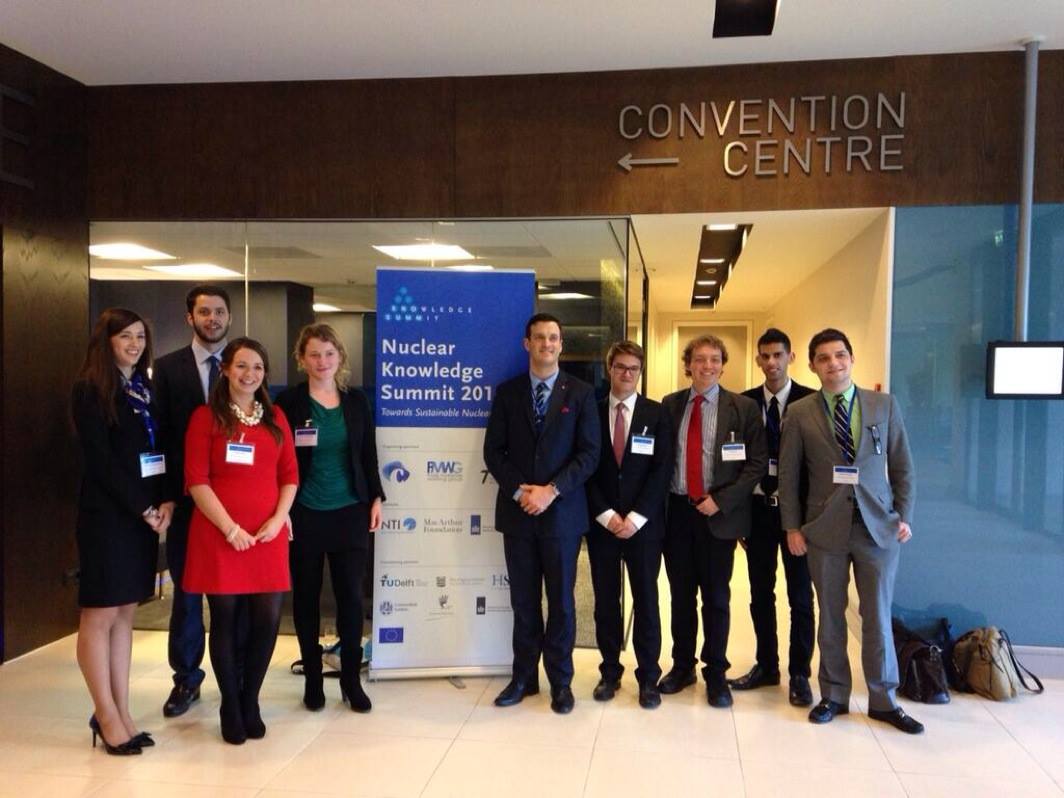

THE YEL, YDC AND PUSH! DELEGATIONS TOGETHER AT THE NKS.

More importantly, through the PUSH! for Disarmament group’s production, the youth voice was the only one to be granted the privilege of presenting a video at the closing ceremony of the NKS. This was a significant, and symbolic accomplishment.


PUSH! PRESENTS AT THE CLOSING CEREMONY

During the NKS, delegates listened to a variety of high level speakers from across the nuclear industry. Among the speakers was a critical address from the Director of Nuclear Security at the International Atomic Energy Agency, Dr. Khammar Mrabit, who opened the NKS with a thought-provoking assessment on the state of nuclear security. As part of the first panel on “Improving Regime Cohesion”, Dr. Mrabit set out a complete plan for continuing with the spirit of the Nuclear Security Summit efforts after the present round of bi-annual summitry runs its course. (This theme will be explored in depth by the YDC Delegation in its forthcoming research paper).


THE IAEA NUCLEAR SECURITY PLAN PRESENTED BY IAEA DIRECTOR OF NUCLEAR SECURITY, DR. KHAMMAR MRABIT

Further panels included a discussion on cybersecurity and the nuclear industry, which was a hot topic and one that garnered extensive attention from the audience during the question and answer period. Bringing much needed global perspective was the panel on “Regional Approaches to Nuclear Security”, which assessed specific issues related to security concerns in all corners of the world. Directly related to this challenge was the panel on securing fissile materials and radiological sources – both are key elements for the peaceful nuclear energy industry, but are vulnerable to theft from terror groups who seek to use the materials for nuclear attacks.

Outside of the formal program, the YDC Delegates were able to network with these nuclear experts, discuss common concerns and continue the panel discussions in greater detail. Through official meals, the Delegates had a chance to mingle in a more casual setting, and get to know the other youth delegations.


THE YDC DELEGATION ENJOYS DINNER DURING THE CLOSING CEREMONY.

Leaving the NKS, the key theme that the YDC Delegates took away is that the bi-annual Nuclear Security Summit (NSS) process will likely come to an end in 2016. As such, meetings such as the NKS are vital to ensuring that the global dialogue about these issues not only continues, but is continued in a comprehensive, targeted and logical way.

Whichever format future nuclear security meetings will take, through participation in events like the NKS, the Young Diplomats of Canada seeks to build Canada’s next generation of global leaders through access to hands-on diplomatic events.

Robert D. Onley was the Head Delegate of the Canadian Delegation at the 2014 Nuclear Knowledge Summit in Amsterdam, and serves as Legal Counsel and Director of Policy and Development for the Young Diplomats of Canada. He can be contacted at legal@youngdiplomats.ca.

Wednesday, September 4, 2013

Did Vladimir Putin Bait a Trap for the United States in Damascus?

Utterly fascinating proposition. A must read.
 
Did Vladimir Putin Bait a Trap for the United States in Damascus? - Tablet Magazine
http://www.tabletmag.com/jewish-news-and-politics/143492/samuels-syria-vladimir-putin

"By showing that Obama’s America is unable and unwilling to keep its promises, Putin has widened the leadership void in the Middle East—as a prelude to filling it himself. By helping to clear Iran’s path to a bomb, Putin positions himself as Iran’s most powerful ally—while paradoxically gaining greater leverage with Saudi Arabia and the other Gulf States, who would much rather negotiate with Russia than with Iran, their sworn enemy."
 
Is Putin really that crafty? Hard to say. But I wouldn't put it past the Russian president. Putin has shown his willingness to stick it to Obama on numerous occasions. - R.O.

Friday, August 2, 2013

Ontario Throws a Bucket of Cold Water on Iran

By Avi Benlolo
President and CEO, Friends of Simon Wiesenthal Centre   
August 2, 2013
 
This week marked an important turning point in Ontario's awareness of determined and well-funded efforts to undermine the values and conceptual underpinnings of Canadian society by groups hoping to import a toxic and foreign ideology to our nation.
 
Nowhere was this effort more evident than the staging of the 'Al Quds Day' rally, held for the past two years on the grounds of Queen's Park. Al Quds Day was proclaimed on the last Friday of the month of Ramadan in 1979 by Ayatollah Khomeini of Iran to spread the demonization of western values of freedom and democracy around the world.
 
In past rallies, participants carried Hezbollah flags, flaunted pictures of despotic Iranian leaders and promoted anti-Semitism by referring to Israel as a "cancer." Chants of "Death to Israel and Death to America" are typical features of Al Quds celebrations. Irans's new "moderate" president-elect, Hasan Rouhani, today re-iterated the same genocidal phrases as his predecessor when he noted, "the Zionist regime has been a wound on the body of the Islamic world for years and the wound should be removed."
 
Hundreds of protesters had planned to gather this Saturday on the grounds of the Ontario legislature, the heart of our provincial democracy, to support a regime that stones women to death, hangs homosexuals, funds the ongoing slaughter of thousands of Syrian civilians and exports terror around the world. From failed terror plots in such disparate locations as Azerbaijan, Thailand and Cyprus, to tragically successful bombings which killed and maimed scores of innocent people in countries including Bulgaria and Argentina, Iran is working to further its influence and ideology through terror. Chillingly, it is gaining support for these goals through Al Quds Day rallies, now held annually around the globe.
 
It is not only Jewish communities and Israelis - threatened repeatedly with annihilation by Iran, who are alarmed by the subversion of our democracy and the staging of this annual pro-Shariah rally. A large percentage of the ex-patriot Persian community, - men and women who escaped the atrocities of the Iranian government and now find themselves battling the same hatred and intolerance they sought to escape, are similarly troubled.
 
I have always believed it is morally wrong to sanction a rally in support of a demagogue and an ideology that is diametrically at odds with the basic Canadian values of freedom and democracy. Ontario is a free society, and its citizens have a right to march, to speak, and to protest freely. However, supporters of a genocidal regime which aims to fundamentally reshape western democracies by exporting the values of Shariah law should not and do not have to receive the blessing of the state to exercise this right. The fundamental values cherished by all Canadians must not be discarded so cavalierly with the acquiescence of our government and the permission of our laws.
 
Ironically, it is this very same right to freedom of speech which is denied to millions of Iranian men and women persecuted by their own government; it is the right to think and speak freely which led so many Iranians to come to Canada, and the fear of losing these precious rights through the negligent support of this rally, and all it stands for, which causes such great alarm.
 
In the words of Marina Nemat, an Iranian-Canadian author who has written and spoken extensively about her imprisonment and torture in Iran's Evin prison by the Khomeini regime at the age of 16, "Freedom is like water in the palms of your hands; take your eyes off it, even for a little while, and it drips through your fingers, leaving nothing but thirst."
 
And so it was a welcome surprise to learn that Ontario's Sergeant-at-Arms has refused permission for organizers to hold the Al Quds day rally tomorrow. It seems discussions I had last year with the Sergeant-at-Arms, as well as meetings he held with other leaders in both the Jewish and Iranian communities, have forced government officials to pay attention to this treasonous event happening in their own front yard.
 
As the Iranian foreign ministry condemns the fledgling peace talks between Israelis and Palestinians, and alarm grows in Washington about the increasing influence of Iran in Latin American countries such as Cuba, Ecuador, Nicaragua and Venezuela, I am proud to see that our government, and the individuals elected to protect the fundamental and indispensable principles upon which our province and our nation are based, finally have their eyes on a truly essential matter.
  
CLICK HERE to read FSWC's letter to the Ontario Speaker of the House re the Al Quds Day Rally

Tuesday, June 25, 2013

Baird: Iran has just “2 or 3 months” to change course, diplomatic process “nearing the end.”

These are critical insights into a tense state of affairs. With Syria on the mainstream news media's front burner, the Iranian nuclear crisis has been left to simmer. But with newly elected Iranian President Rouhani set to take office in Iran, the world's focus will soon shift back to Iran's covert nuclear weapons program and all of its perilous implications for global stability. The following comments from Canadian Foreign Minister John Baird are worth reading, as they implicitly represent the perceptions of the Israeli government. The question is whether U.S. President Obama is feeling the same way. - R.O.

Canadian Foreign Minister: Iran has just “2 or 3 months” to change course, diplomatic process “nearing the end.”
- Flash Traffic Blog - June 25, 2013
By: Joel C. Rosenberg

(Jerusalem, Israel) – After having just been in Ottawa meeting with Canadian Members of Parliament to discuss Israel and Middle East issues, I’ve now been in Israel for ten days of meetings and preparations for our upcoming Joshua Fund tour and Epicenter Conference. I was encouraged to read this morning that the Canadian Foreign Minister John Baird was recently in town to meet with Prime Minister Netanyahu and other Israeli and Palestinian officials. His comments on the Iran threat were worth noting because he indicated a concrete time frame by which Iran needs to show it has ended its nuclear program or other action — decisive action — needs to be taken. Coming from the most pro-Israel government on the planet, this was encouraging. My hope is that the Foreign Minister was also laying the groundwork for a state visit by Canadian Prime Minister Stephen Harper, but there was no public report of this.

”Canada’s  foreign minister has warned Iran that it has only two to three months to prove to the West that it seeks a negotiated resolution to the crisis over its rogue nuclear program,” reports the Times of Israel “The diplomatic process is ‘nearing the end,’ John Baird said in an interview with The Times of Israel, though he declined to say what consequences that could bring.”

“He added that the election to the Iranian presidency of Hasan Rouhani, seen by many as a relative moderate, does not justify any further Western patience, since Rouhani, as Iran’s former nuclear negotiator, ‘doesn’t need to have any time to read up on the files,’” reported the Times. “Baird was speaking exclusively to The Times of Israel last week during a visit to Jerusalem, where he represented Canada’s government at Shimon Peres’s Facing Tomorrow presidential conference, and met with Prime Minister Benjamin Netanyahu. He also went to Jordan during the trip, and held talks in Ramallah with the Palestinian Authority President Mahmoud Abbas and other senior PA officials.”

Other key points from the article:

- If incoming president Rouhani “wants me to say something kind or generous, he’s going to have to solicit that by his actions, not by any perceived notion of being a reformer,” Baird said, adding, “These people don’t deserve the benefit of the doubt.”

- Asked whether diplomacy had run its course, Baird said, “There’s always a reason to wait another two or three months… If they want to prove the naysayers wrong, they can make meaningful progress with the P5+1. I’m pessimistic on that but I hope to be proven wrong.”

- The diplomatic process, he went on, “is nearing the end, and should have been nearing the end in my judgment. If Iran wants to seek out concrete, meaningful solutions to this, they have the opportunity to demonstrate to the world in the coming weeks that they’ll do that… And you have someone [in Rouhani, a former Iranian nuclear negotiator] who doesn’t need to have any time to read up on the files. This person does not need anytime to be briefed up.”

- And if at the end of two or three months there isn’t some kind of concrete progress? Then, said Baird, “I think fair and reasonable people will have shown that they have taken every reasonable measure, every diplomatic measure, to try to successfully bring this to a conclusion.”

And then comes the time for intervention? “I’ll just leave it at that,” the minister said.

June 25, 2013

Monday, June 17, 2013

The Future of Global Diplomacy

Here is my latest op-ed, "The Future of Global Diplomacy", published today by the Canadian International Council at the opening of the G8 Summit in Northern Ireland. I discuss the Y8 and Y20 Summits which also open this week and next, which bring together the leading graduate and young professional minds from around the world, for a week-long series of negotiations amongst the global youth. Check it out below. - R.O.
--------------------------------------------------------------------
The Future of Global Diplomacy
Robert Onley | June 17, 2013
Reuters
The leaders of the G8 are convening in Northern Ireland for the 39th G8 Summit. The backdrop for this two-day meeting of the globe’s preeminent economic powers is a world facing multiple global crises, all of which demand that summit participants engage in constructive dialogue that leads to measurable progress. Despite that need, the annual G8 Summits are known more for eliciting empty political promises and saddling host cities with exorbitant costs.

In 2013, this geopolitical lip service simply will not cut it, as the world leaders of tomorrow are demanding results.

The baby boomer generation presidents and prime ministers at the G8 Summit are facing increasingly frustrated populations. With economic instability entrenching in the West, a still teetering world financial order, and escalating tensions in the Middle East, an entire generation of young people is growing up without opportunity, and with few prospects for change. But persistent unemployment, declining standards in health care and education, and environmental degradation are also driving growing numbers of young people to demand sophisticated and coordinated global action.

From this mess, two significant questions arise: are the boomer generation leaders simply incapable of consensus-driven international cooperation, one that sets aside national interests for the collective good of humanity? And if this is the case, are tomorrow’s Facebook generation leaders damned to inherit the quagmire of their political predecessors?

These are the serious, credible questions that today’s brightest 20-something leaders have asked themselves, and which they have actively set out to answer together through their own international diplomacy at the 2013 Y8 and Y20 Summits being held in London, UK (June 24-28) and St. Petersburg, Russia (June 18-20), respectively.

These are not mere “Model U.N.” simulations: the Y8 and Y20 Summits are the world’s premier youth assemblies, bringing together graduate students and young professionals from across the G20 for a week of intensive negotiations, dialogue, and bargaining. Whether or not any of the delegates at the Y8 and Y20 Summits end up in a prominent political office, these young minds have already created space for meaningful change, via the creation of a global network that has the potential to fundamentally reshape the dynamics of international diplomacy and global governance for decades to come.

Unlike their boomer political forebears, the leaders of the Facebook generation are “digital natives”, accustomed to instantaneous communication, and constant updates on the personal, political, and career decisions of their peers. Every day, they exploit social networks to grow and sustain an online community comprised of the most engaged and committed student leaders from across the G20. These new generation leaders are utilizing all available tools and innovations to exchange ideas, think critically and solve problems together, well before entering into positions of power. The Youth Summits are simply the annual physical manifestation of the dynamic online relationships among future leaders.

This year marks the 7th anniversary of the Youth (“Y”) Summits, which are formally sponsored by the presidents and prime ministers of the actual G8 and G20. The 2013 Y8 Summit in London has been organized by the UK-based International Diplomatic Engagement Association (The IDEA), a global network composed of ascending young leaders from all different cultural backgrounds. The 2013 Y20 Summit in Russia is the official G20 youth event, held under the Russian G20 Presidency alongside with G20 Leaders’ Summit.

Critically, young Canadian leaders have been a part of this global youth diplomatic network since its inception in 2006. The IDEA’s Canadian partner is YouthCan for International Dialogue (YFID), a federal non-profit, non-partisan, youth-led think tank responsible for recruiting and selecting Canada’s delegates at the Y8 and Y20. YFID seeks to engage Canadian young leaders in diplomacy and meaningful dialogue at an international level, through access to hands-on global initiatives and diplomacy. YFID targets Canadian undergraduate and graduate students, as well as young professionals from all disciplines, focusing on highly accomplished academic and intellectual leaders with experience in negotiation, debate, and advocacy.

Delegates are selected by YFID for portfolio positions that replicate their real-life national counterparts, be it the Prime Minister, or Ministers of Defence, Foreign Affairs, Finance, Environment and Health. In the months and weeks leading up to the Summits, delegates from around the globe utilize social networking tools like Facebook, LinkedIn, Google Docs, and Podio to debate and determine their agenda topics for the actual negotiations. The Y8 and Y20 Summits are unique in that delegates are given the freedom to approach global issues using any theory, opinion, or proposal available. The goal of the Youth Summits is not to mimic each nation’s standing policies, but rather to capture the spirit, ideas, and consensus of the globe’s next generation of leaders.

The catch is that all proposals must be achievable (no utopian idealism allowed), tangible (results-based), and more importantly, must be simultaneously agreed to by the rest of the Y8 or Y20 delegates. While skeptics may assume that the end result of these negotiations is series of far-flung “save-the-world” panaceas, past Youth Summits have shown that the negotiations produce hard-fought, comprehensive, genuine solutions to complex world problems.

The final byproduct of a week-long series of negotiations is the Final Communiqué, which is presented to the national president or prime Minister of the respective G8 and G20 (Read the 2011, 2012 communiqués). However, in many respects, more important than this policy paper is the creation of a lasting social and digital network of aspiring young leaders – one that grows in number and depth with each passing Youth Summit. Many youth delegates, like their real-life counter-parts, return year to year, cementing personal relationships with friends and national rivals alike. Empowering all of this, of course, are online social networks.

In recent years the world witnessed the power of these networks to organize protests, spread political messages, and even help topple governments and national leaders. Today, social media is often idolized as a force equalizer, empowering the “people” vis a vis their elected or non-elected “leaders”.

Less well understood is how online social networks may come to impact decision-making processes at the global level: will they change how individual leaders conceive of and approach problems, and the tools they choose to use to deploy? Social networks have yet to positively change how the boomer generation does business, however, as the Y8 and Y20 Summits demonstrate, the next generation of leadership will be composed of twenty-somethings who recognize the power of online relationships in navigating geopolitics, and collaborate in finding solutions to global crises.

Our current leaders are faltering, but there is no small measure of comfort to be found in the skills, determination, and connections among those who will follow them.

You can follow YFID during the Summits at: @YFIDCanada and Facebook.com/CanadaYFID

Monday, May 20, 2013

Russia's Brinkmanship with US Clashes with Israel's Security

A brief summary of Russia's recent foreign policy moves and how they impact Israel. Does Russia think there won't be consequences for supporting terror states like Iran and Syria? -R.O.

Middle East and Terrorism: Russia's Brinkmanship with US Clashes with Israel's Security

by Yaakov Lappin

"Jerusalem will find Russia's delivery of the S-300 missile system to Syria to be an intolerable development; it is safe to assume that Israel will act to prevent this from happening."

Russia is aggressively squaring off with an indecisive and rather meek West about Syria, and in the process, is also threatening to undermine Israeli efforts to ensure that Iran and Syria do not ship strategic weapons to Hezbollah.

The Syrian civil war has become a dangerous and complex battle of multiple actors and their proxies: Sunni versus Shi'ite, Iran versus the Gulf states, Al-Qaeda versus Hezbollah, and on a global scale, the United States versus Russia.

Moscow is trying to deter a potential US or NATO-led initiative to set up a no-fly zone over areas of Syria, and is seeking to stop Western-led air strikes against chemical weapons sites.
Russia also seems concerned that recent air strikes in Damascus targeting Hezbollah-bound guided Iranian missiles -- strikes attributed by the foreign media to Israel -- will pave the way to such an intervention.

Israel has no interest in getting involved in the Syrian civil war. Rather, it is looking out for the safety of millions of citizens, who already live in the shadow of some 80,000 Hezbollah rockets, and would be threatened further by the transfer of precise, powerful missiles to Hezbollah in Lebanon.

In recent days, Russia unleashed a flurry of moves to establish its support of Syria.

The Russian moves include: Declaring that it will proceed with deliveries of the advanced S-300 air defense system to Assad, mobilizing war ships to the eastern Mediterranean, and selling sophisticated surface-to-sea Yakhont missiles to Assad.

Moscow's recent maneuvers might be more bluster than real -- the S-300 has yet to be delivered, and Russia was in 2010 talked out of selling the formidable air defense system to Iran.

The threat, however, was serious enough for Israeli Prime Minister Binyamin Netanyahu to make an unscheduled trip last week to Russia to meet with President Vladimir Putin. The two later held a press conference, repeating their public positions, but it is doubtful that those statements were a complete reflection of their private exchange.

Israel is opposed to Assad receiving the S-300 missile for several reasons: With its sophisticated radars and range of 200 kilometers, the S-300 can hamper Israel Air Force aircraft seeking to monitor Hezbollah in Lebanon. The system can also disrupt future Israeli efforts to intercept the transit of Iranian weapons to Hezbollah through Syria. Finally, Assad can choose to smuggle S-300 batteries to Hezbollah or Iran.

Should the S-300 fall into Iranian hands, the future potential mission of launching a military strike on Iran's developing nuclear program would be more even more complex than it already is. Knowing that the S-300 was in Hezbollah's hands, and could target Israeli aircraft sent to stop it, would only boost the Shi'ite terror organization's confidence to launch cross-border attacks on Israel. For these reasons, Jerusalem will find Russia's delivery of such a system to Syria to be an intolerable development; it is safe to assume that Israel will act to prevent this from happening.

Similarly, the Russian Yakhont missiles already delivered to Syria threaten Israel Navy ships carrying out vital missions in the Mediterranean.

Behind closed-doors, intense diplomacy -- including the sudden visit by CIA Director John Brennan to Israel -- is underway to try and contain these developments, and prevent them from triggering further regional security deterioration.

Yaakov Lappin

Source: http://www.gatestoneinstitute.org/3722/russia-syria-israel

Copyright - Original materials copyright (c) by the authors.

Thursday, May 16, 2013

Russia vows response against Israel for future Syria strikes

The story below fits as a scenario that could lead to the prophesied war found in the book of Ezekiel, chapters 38 and 39. In that prophecy, Biblical scholars (among them Joel Rosenberg who I interviewed in 2010) generally agree that Gog, a large kingdom from the north of Israel, will join forces against Israel's enemies to destroy Israel in the last days. 

Carefully read Ezekiel's prophecy above in the context of the story below: Russian President Vladimir Putin is allegedly pledging to retaliate against Israel, if Israel conducts another strike on targets inside Syria. 

At the same time, yesterday (May 15, 2013), the Israeli government publicly pledged to "bring down" Syria's President Assad if Assad retaliates against Israel for Israeli air strikes inside Syria on missiles and weapons systems bound for Iran's terrorist proxy militia Hizballah in southern Lebanon. 

The threat posed to Israel by all of these interconnected alliances is compounded by Israel's long-rumoured potential mission to conduct air strikes against Iran's nuclear facilities and missile sites. In short: the Middle East is at the precipice of total conflagration.

The truth and potential fulfillment of the Bible's prophecies in Ezekiel is becoming explicitly clear, and is worthy of critical assessment by believers and non-believers alike. What if the as-yet-unfulfilled prophecies written 2500 years ago are coming true in this lifetime? Christians are commanded to pray for the peace of Jerusalem (Psalm 122:6). In light of the likelihood of massive global war, perhaps non-Christians should be praying that too. 


Even so, come Lord Jesus (Rev. 22:20).
-R.O.
-------------------------------------------------------------------------------------------------------------------------------

"Syrian-Israeli war of words via Putin edges into Syrian-Hizballah war of attrition"

DEBKAfile Exclusive Report May 16, 2013, 10:58 AM (IDT)

Russian President Vladimir Putin and Prime Minister Netanyahu ended their three-hour meeting in Sochi Tuesday, May 14, at loggerheads on Syria. In fact, Putin warned his guest that Israel and its army, the IDF, were heading for war with Syria in which Russia might well be involved – and not just through the advanced S-300 anti-air missiles supplied to the Assad government.

The case Netanyahu and Military Intelligence chief Maj. Gen. Aviv Kochavi put before Putin and Russian foreign intelligence chief, SVR Director Mikhail Fradkov, fell on deaf ears.

They found the Russian leader further infuriated by the docking that day at Israel’s Red Sea port of Eilat of the USS Kearsarge, carrying 1,800 marines and a consignment of 20 V-22 Osprey helicopters which US Defense Secretary Chuck Hagel had promised to supply to Israel during his April visit.

Putin viewed the stationing of US forces in the Gulf of Aqaba just two hours away the Israeli-Syrian border for repelling Syrian-Iranian-Hizballah aggression against Israel or Jordan – signaled by the Kearsage’s arrival - as an act of bad faith by Washington. On the one hand, they want us to cooperate for an international conference to end the bloodshed in Syria, while on the other, they deploy military forces, he complained to Netanyahu.

The Israeli prime minister countered with a warning that Israel would continue to strike advanced weapons in Syria that were destined for Hizballah. And if President Bashar Assad hit back for Israel’s May 5 bombardment of weapons stores on Mount Qassioun near Damascus, Israel would intensify its bombardments of Syrian military targets and weapons until Assad was left to fight off rebel assaults empty-handed.

Putin rejected this threat as implausible.

Neither Putin nor Netanyahu put all their cards on the table, but the conversation ended with the Russian leader fully confident that his capabilities for safeguarding Assad were greater than Israel’s ability to destroy him.

In the end, Netanyahu and his party arrived home Tuesday evening with a bad feeling. They were certain that Moscow had given Assad the green light to go through with his threat to make the Syrian Golan and the Horan of southern Syria “a front for resistance” – i.e. the platforms for embarking on a war of attrition against northern Israel with the help of a flow of advanced weapons to Hizballah.

The Syrian ruler is strongly encouraged to adopt this path by Tehran. Hizballah’s leader Hassan Nasrallah has embraced it. And the radical Palestinian leader, Ahmed Jibril, head of the Assad-satellite Popular Front-General Command, has eagerly offered his services.

And indeed, Wednesday, the day after Netanyahu’s trip to Sochi, Jibril’s group let loose with mortar fire on the Israeli Mt. Hermon ski site, firing from a Syrian army position.


Israeli military sources confirmed later that these were no stray shells from a Syrian-army-rebel battle as in former cases, but a deliberate attack. In Jerusalem, it was taken as a direct consequence of Moscow’s account to Assad of the conversation between the Russian and Israeli leaders. They concluded that Assad took it for granted that he was now at liberty to go on the offensive against Israel.

Wednesday night, Netanyahu’s office reacted to this deterioration with a swift and strong warning.
Israeli media were informed bluntly that if the Assad chose to retaliate for Israel’s air strikes, he would be removed from power.

That same night, “a senior Israeli official” contacted The New York Times with a more detailed warning quoted by the paper: "If Syrian President Assad reacts by attacking Israel, or tries to strike Israel through his terrorist proxies, he will risk forfeiting his regime, for Israel will retaliate."

Within hours, early Thursday morning, May 16, Jerusalem had its answer from Damascus.
A Palestinian group calling itself “Martyrs of the Abdel Qader al-Husseini Brigades” (named for the commander of a Palestinian force fighting Israel in its 1948 War of Independence) claimed responsibility for the "rockets" aimed at an Israeli military observation post in the Golan Heights. They were fired in honor of Nakba Day, said the statement released in Damascus "We are not celebrating but avenging the blood of our martyrs."

A video showing the launch was appended.

Palestinian terrorist groups habitually use made-up names when claiming attacks, a practice often followed by al Qaeda, but this one was easily identified by Israel and taken to mean that Assad had begun using what the Israeli official referred to in The New York Times as "his terrorist proxies."

Depending on the next move decided on by Prime Minister Netanyahu, Defense Minister Moshe Ya’alon and Chief of Staff Lt. Gen. Benny Gantz, this incident could mark the tipping-point of a slide towards a war confrontation against Israel by Syria, Hizballah and other Assad proxies.