Showing posts with label Jordan. Show all posts

Saturday, January 17, 2015

The Islamic State's Third Target - An Interview with Joel C. Rosenberg

This week I was honoured to interview New York Times bestselling author Joel C. Rosenberg about his new novel, The Third Target. As a longtime fan and follower of Rosenberg's work, I was intrigued at the opportunity to speak with him again, following my first interview with him back in June 2010 in an article later published in the Jerusalem Post.

Below is my latest interview with Rosenberg, published today in the Times of Israel. Read it here: http://blogs.timesofisrael.com/the-islamic-states-third-target/

The Islamic State's Third Target
By: Robert D. Onley - Times of Israel - January 17, 2015

With reports indicating that Islamic State militants are managing to gain territory in Iraq and Syria in spite of US and coalition air strikes, the world is witnessing a nightmare scenario unfold across the Middle East: what if the Islamic State simply cannot be stopped?
In New York Times bestselling author Joel C. Rosenberg’s latest novel, The Third Target, this troubling question is examined in serious, careful detail. Known for eerily prescient political thrillers whose plots accurately predicted hijacked airliners attacking the United States, the Iraq War, and the death of Yasser Arafat (among other major geopolitical events), Rosenberg and his books rocketed in popularity over the last fifteen years.

The Third Target
After writing extensively about radical Islam in both fiction and nonfiction, from Sunni jihadists with AK’s to Shia theocrats pursuing nuclear weapons, last year Rosenberg set out to examine whether a terror threat existed that he was not yet aware of, but ought to be.
Helping his investigative efforts, Rosenberg is a former advisor to Prime Minister Netanyahu with an extensive network of friends and officials whom he tapped to explore the question above. In researching The Third Target, Rosenberg met with two former heads of the CIA, R. James Woolsey and Porter Goss, and the former head of the Mossad, Danny Yatom, among many other intelligence officials. Months before the Islamic State, or ISIL, burst onto the international scene, the answers Rosenberg heard separately from these intelligence chiefs were both unanimous and chilling.
“They each were concerned that Al-Qaeda in Iraq was morphing into something new, something more dangerous,” Rosenberg says. In early 2014, while President Obama went on the record claiming that ISIL was merely a “jayvee team” and hardly worth worrying about, Rosenberg stated, “These officials warned me that what kept them up at night was the rise of this Al-Qaeda offshoot, ISIL, and the reality that an Islamist-led overthrow of Jordan was a genuine worst-case scenario and a possibility.”
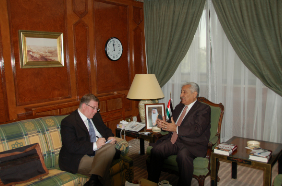
Rosenberg meeting with Jordan’s Prime Minister Abdullah Ensour in Amman as part of the research for “The Third Target.”
These foreboding comments prompted Rosenberg to dig further. After more meetings in Washington, he traveled to Jordan, meeting with Jordan’s Prime Minister Abdullah Ensour, Foreign Minister Nasser Judeh, and Interior Minister Hussein Al-Majali to discuss regional threats. Mentioning potential plot ideas, including a chemical attack and the risk of an overthrow, Al-Majali responded to Rosenberg, “the King has appointed me to make sure the scenario that you are writing about will never happen in our country. But it is a plausible scenario, and that is the problem.”
“What if ISIL tries to set into motion attacks on a number of targets – and what if one of those targets was Jordan, Israel, or the United States?”
After digesting countless intensive interviews with Western and Middle Eastern officials, Rosenberg sat down to write The Third Target, which, soon after the first draft was finished and in light of ISIL’s rapid rise across the Middle East, had its release date pushed up by three months. Published early on January 6th of this year, The Third Target imagines a scenario in which ISIL captures a cache of chemical weapons in Syria, and threatens to deploy them against an unknown city. Rosenberg says,“The question I wanted to ask in this book was, what if ISIL tries to set into motion attacks on a number of targets – and what if one of those targets was Jordan, Israel, or the United States?”
As if the plot was ripped from the headlines and bringing the pages of The Third Target alive, Jordan’s King Abdullah recently stated publicly on CBS News that the battle against ISIL, is, in effect, “our generation’s Third World War.” But in order to stop ISIL and thwart any attempt to attack Jordan, Rosenberg believes that President Obama and the leaders of NATO must view ISIL as “such a significant threat to national security” that the US takes “decisive military action, with no more half measures.”
Rosenberg cites a long-list of realistic military actions that the US is not currently conducting to help destroy ISIL, including not allowing U.S. Special Forces on the ground to provide precise targeting for air strikes, and not permitting 24/7, 7-day a week airlifts of supplies to Kurdish troops fighting in northern Iraq, “even though the Kurds are the most aggressive fighters and the most immediately endangered by ISIL.”
Critiquing the Obama Administration, Rosenberg pulls no punches, saying of Obama’s half-hearted campaign against ISIL that, “This is not working. This is not decisive action. This is foreign policy by press release.” Arguably Obama’s failure to act decisively also lends credibility to the terrifying potential for the ISIL-led chemical weapons attack that is envisioned in The Third Target.
“Obama is also missing the greatest strategic alliance against radical Islam in history.”
But beyond the US not showing up in Paris to show solidarity following the Charlie Hebdo attacks, Rosenberg notes that, “Obama is also missing the greatest strategic alliance against radical Islam in history.” Rosenberg believes three men emerging who are the “Winston Churchill’s of our time, and none of them are in London, Paris or Washington. They are all in the Middle East.”
Rosenberg lists Israel’s Prime Minister Netanyahu, Jordan’s King Abdullah II, and Egypt’s President el-Sisi, as the only global leaders who truly see the existential threat posed to them and to their people by two different, but equally radical Islamic forces: the Shia radicals in Iran, and the Sunni radicals of ISIL. “President el-Sisi and King Abdullah have no qualms calling this a battle against radical Islam,” Rosenberg pointed out, “while President Obama and his Press Secretary refuse to use the term ‘radical Islam’ for fear of being ‘offensive.’” The difference in mentality could not be more stark.
Not only is Jordan committed to fighting radical Islam militarily, Rosenberg says King Abdullah II and his team are also committed to deconstructing radical Islam theologically, stating, “I sat with the King’s men, who explained how they are rallying support among hundreds of Islamic scholars all across the Middle East and the world to explain their version of moderate Islam, and to deconstruct what they call takfiri Islam, which is what the radicals believe.”
“President el-Sisi told the imams that they “must revolutionize and reform modern Islam”, with Rosenberg adding, “Sisi did so at a real risk to his own life in Egypt.”
Rosenberg further cited Egyptian President el-Sisi’s recent speech to Muslim clerics on New Years Day, where el-Sisi told the imams that they “must revolutionize and reform modern Islam,” with Rosenberg adding, “Sisi did so at a real risk to his own life in Egypt.” Netanyahu similarly has spoken out against the threat of radical Islam on numerous occasions. All the while, Rosenberg says, “These are allies at risk, and Obama simply won’t help these men win the battle.”
As ISIL marches, the regular stream of their grotesque snuff films continues to inundate the mainstream news. On the surface, the incomprehensibly evil actions of ISIL seem to be the product of mass delusional hysteria – violence for the sake of violence. But Rosenberg hints at a deeper motive for ISIL and their ilk, one grounded in a strict interpretation of the Quran and hadiths.
“Both the radical Sunnis and Shias have an eschatology – or End Times belief system – that talks about establishing the Islamic Kingdom or Caliphate: the radical Shias are waiting for their Messiah while they build nuclear weapons, before picking an apocalyptic fight with the West or another nation in the region,” Rosenberg explains.
“ISIL…[is] building the Caliphate now, desperately trying to usher in End of Days by killing and enslaving those caught up in their apocalyptic, genocidal vision.”
However Rosenberg contrasts this belief with those of radical Sunnis, such as ISIL, who he says have decided not to wait: they are building the Caliphate now, “desperately trying to usher in End of Days by killing and enslaving those caught up in their apocalyptic, genocidal vision. I spoke to one Pastor in Iraq, who said to me: ‘Joel, this is demonic. When ISIL chops off someone’s head, this is not just terrorizing – these are blood sacrifices to the Islamic State’s ‘God’.’ These are the genocidal conditions emerging in Iraq and Syria.”
In writing The Third Target, Rosenberg hopes to bring readers into the ‘living room’ of the savage, barbaric mindset of ISIL, to help people see how urgent the threat is, and explore why we must act decisively to crush it, “When I started to write this book, I was thinking that the threat was 4 to 5 years away. It moved much faster than I expected.”
Underscoring the intensity of Joel Rosenberg as an author and advocate, and emphasizing his passion when speaking out about these issues, Rosenberg and his family recently made Aliyah to Israel after living their entire lives in the United States. As an evangelical Christian with a Jewish father, Rosenberg says that he wants to use his novels “to inform people in the West, generally, and Christians in particular, that now is the time to stand with Israel, Jordan, Egypt, and all people of good will who will fight against radical Islam.”
He says that he is honoured to stand with Israel in this fight, and notes that in due time his sons will be drafted to serve to protect Israel, “I believe that there is a great movement of Christians around the world who love Israel, who are standing with the Jewish People, and that my role and contribution to Israeli society is trying to educate and mobilize that Christian support for Israel, especially at this time, when the battle against radical Islam is so urgent.” The Third Target is his latest salvo in that fight.

Wednesday, November 7, 2012

UK leads calls to 'shape' Syria opposition - Al Jazeera

Very interesting development within hours of Barack Obama's re-election: the UK is now saying it will "deal directly with rebel military leaders" in Syria. Is this the right move for the West? Should Western governments escalate the conflict there? Were Western nations simply waiting for the US election to finish before deciding their next move? 

The answer to the latter question seems obvious, as NATO allies (such as the UK) are now openly advocating for an escalation of support for Syrian rebels. The question is: what is the West's end game in Syria? After Assad is toppled, who will take control? Will they take control? Are the "rebels" people that the West can trust? What about the extremist factions within the Syrian rebellion?

My fear is that, like Iraq, the West will entrench itself in another intractable sectarian conflict, one that this time borders Israel. This is certainly a story to watch. - R.O.

UK leads calls to 'shape' Syria opposition - Al Jazeera

British Prime Minister David Cameron said UK and allies should do more to open direct communication with rebel leaders.

Western efforts to oust Syrian President Bashar Assad have shifted dramatically, with Britain saying it will deal directly with rebel military leaders and Turkey saying NATO members have discussed protecting a safe zone inside Syria with Patriot missiles.

The developments came within hours of President Barack Obama's re-election on Tuesday, which US allies said they have been waiting for before implementing new strategies to end the deadlocked civil war that has killed more than 36,000 people over the past year and a half.

British Prime Minister David Cameron, visiting a camp for Syrian refugees in Jordan, said the US, Britain and other allies should do more to "shape the opposition'' into a coherent force and open channels of communication directly with rebel military commanders.

Previously, Britain and the US have acknowledged contacts only with exile groups and political opposition figures inside Syria.

And a Turkish official said Turkey and allies, including the United States, have discussed the possibility of using Patriot missiles to protect a safe zone inside Syria.

The foreign ministry official, who spoke on condition of anonymity because of ministry prohibitions on contacts with the news media, said planning for the safe zone had been put on hold pending the US election.

He said any missile deployment might happen under a "NATO umbrella'', though NATO has insisted it will not intervene without a clear United Nations mandate.

"There is an opportunity for Britain, for America, for Saudi Arabia, Jordan and like-minded allies to come together and try to help shape the opposition, outside Syria and inside Syria,'' Cameron said. "And try to help them achieve their goal, which is our goal of a Syria without Assad.''

International pressure
Cameron is currently on a tour of the Middle East and speaking on Obama's re-election said: "I am hearing appalling stories about what has happened inside Syria so one of the first things I want to talk to Barack about is how we must do more to try and solve this crisis.”

The news comes as the Syrian National Council's (SNC) general assembly of nearly 420 members met on Wednesday to choose two leadership bodies and a president during a conference in the Qatari capital Doha.

Syria's main opposition bloc has succumbed to intense international pressure from critics and begun electing new leaders to appease critics who say the exile-dominated group does not represent those risking their lives on the frontlines to oust the regime.

The SNC, largely made up of exiles, has been criticised as ineffective and out of touch with those trying to topple Assad.

The US has called for a more unified and representative opposition, suggesting an end to the SNC's leadership.

SNC officials say the internal election may not be enough to deflect such criticism and halt US-backed efforts to set up an alternate leadership group.

Al Jazeera's Omar Al Saleh, reporting from Doha, said: "The new leadership will discuss an initiative given by an opposition member who is also a current of the SNC.

"That initiative is backed by the international community, France, US as well as Qatar, KSA and other countries. According to that initiative, a new council might emerge," he said

"The SNC fears that that council might be a replacement to them and this is for the political wrangling and negotiations will be decisive for the fate of the Syrian revolution" he added.

Tuesday, October 9, 2012

Arab Spring and the Israeli Enemy

The following article was published in Saudi Arabia’s English-language newspaper, the Arab News. The author bravely calls attention to that fact that the bloodshed and suffering of Muslims across the Middle East is occurring at the hands of other Muslims, and not by Israel, and thus questions the anti-Israel narrative venomously espoused across the region. The author notes,
I decided to write this article after I saw photos and reports about a starving child in Yemen, a burned ancient Aleppo souk in Syria, the under developed Sinai in Egypt, car bombs in Iraq and the destroyed buildings in Libya.
A highly worthy read, and a rare, critical Arab voice that needs to be heard around the world. Consider sharing this article with someone you know. Link below. - R.O. 

Arab Spring and the Israeli Enemy
By: ABDULATEEF AL-MULHIM
Saturday 6 October 2012

Thirty-nine years ago, on Oct. 6, 1973, the third major war between the Arabs and Israel broke out. The war lasted only 20 days. The two sides were engaged in two other major wars, in 1948 and 1967.
The 1967 War lasted only six days. But, these three wars were not the only Arab-Israel confrontations.

From the period of 1948 and to this day many confrontations have taken place. Some of them were small clashes and many of them were full-scale battles, but there were no major wars apart from the ones mentioned above. The Arab-Israeli conflict is the most complicated conflict the world ever experienced. On the anniversary of the 1973 War between the Arab and the Israelis, many people in the Arab world are beginning to ask many questions about the past, present and the future with regard to the Arab-Israeli conflict.

The questions now are: What was the real cost of these wars to the Arab world and its people. And the harder question that no Arab national wants to ask is: What was the real cost for not recognizing Israel in 1948 and why didn’t the Arab states spend their assets on education, health care and the infrastructures instead of wars? But, the hardest question that no Arab national wants to hear is whether Israel is the real enemy of the Arab world and the Arab people.

I decided to write this article after I saw photos and reports about a starving child in Yemen, a burned ancient Aleppo souk in Syria, the under developed Sinai in Egypt, car bombs in Iraq and the destroyed buildings in Libya. The photos and the reports were shown on the Al-Arabiya network, which is the most watched and respected news outlet in the Middle East. 

The common thing among all what I saw is that the destruction and the atrocities are not done by an outside enemy. The starvation, the killings and the destruction in these Arab countries are done by the same hands that are supposed to protect and build the unity of these countries and safeguard the people of these countries. So, the question now is that who is the real enemy of the Arab world?

The Arab world wasted hundreds of billions of dollars and lost tens of thousands of innocent lives fighting Israel, which they considered is their sworn enemy, an enemy whose existence they never recognized. The Arab world has many enemies and Israel should have been at the bottom of the list. The real enemies of the Arab world are corruption, lack of good education, lack of good health care, lack of freedom, lack of respect for the human lives and finally, the Arab world had many dictators who used the Arab-Israeli conflict to suppress their own people. 

These dictators’ atrocities against their own people are far worse than all the full-scale Arab-Israeli wars. 

In the past, we have talked about why some Israeli soldiers attack and mistreat Palestinians. Also, we saw Israeli planes and tanks attack various Arab countries. But, do these attacks match the current atrocities being committed by some Arab states against their own people. 

In Syria, the atrocities are beyond anybody’s imaginations? And, isn’t the Iraqis are the ones who are destroying their own country? Wasn’t it Tunisia’s dictator who was able to steal 13 billion dollars from the poor Tunisians? And how can a child starve in Yemen if their land is the most fertile land in the world? Why would Iraqi brains leave Iraq in a country that makes 110 billion dollars from oil export? Why do the Lebanese fail to govern one of the tiniest countries in the world? And what made the Arab states start sinking into chaos?

On May 14, 1948 the state of Israel was declared. And just one day after that, on May 15, 1948 the Arabs declared war on Israel to get back Palestine. The war ended on March 10, 1949. It lasted for nine months, three weeks and two days. The Arabs lost the war and called this war Nakbah (catastrophic war). The Arabs gained nothing and thousands of Palestinians became refugees.

And on 1967, the Arabs led by Egypt under the rule of Gamal Abdul Nasser, went in war with Israel and lost more Palestinian land and made more Palestinian refugees who are now on the mercy of the countries that host them. The Arabs called this war Naksah (upset). The Arabs never admitted defeat in both wars and the Palestinian cause got more complicated. And now, with the never ending Arab Spring, the Arab world has no time for the Palestinians refugees or Palestinian cause, because many Arabs are refugees themselves and under constant attacks from their own forces. Syrians are leaving their own country, not because of the Israeli planes dropping bombs on them. It is the Syrian Air Force which is dropping the bombs. And now, Iraqi Arab Muslims, most intelligent brains, are leaving Iraq for the est. In Yemen, the world’s saddest human tragedy play is being written by the Yemenis. In Egypt, the people in Sinai are forgotten. 

Finally, if many of the Arab states are in such disarray, then what happened to the Arabs’ sworn enemy (Israel)? Israel now has the most advanced research facilities, top universities and advanced infrastructure. Many Arabs don’t know that the life expectancy of the Palestinians living in Israel is far longer than many Arab states and they enjoy far better political and social freedom than many of their Arab brothers. Even the Palestinians living under Israeli occupation in the West Bank and Gaza Strip enjoy more political and social rights than some places in the Arab World. Wasn’t one of the judges who sent a former Israeli president to jail is an Israeli-Palestinian? 

The Arab Spring showed the world that the Palestinians are happier and in better situation than their Arab brothers who fought to liberate them from the Israelis. Now, it is time to stop the hatred and wars and start to create better living conditions for the future Arab generations.

— This article is exclusive to Arab News.
almulhimnavy@hotmail.com